500,000 British Jobs:
Building a Sovereign Energy Workforce
And unlike welfare — it pays for itself.
This section presents a political and economic argument, not a formal fiscal forecast. The core case is that large-scale public employment, domestic supply-chain rebuilding, and import substitution can improve the public finances over time — but exact totals depend on wages, phasing, productivity, and wider policy design.
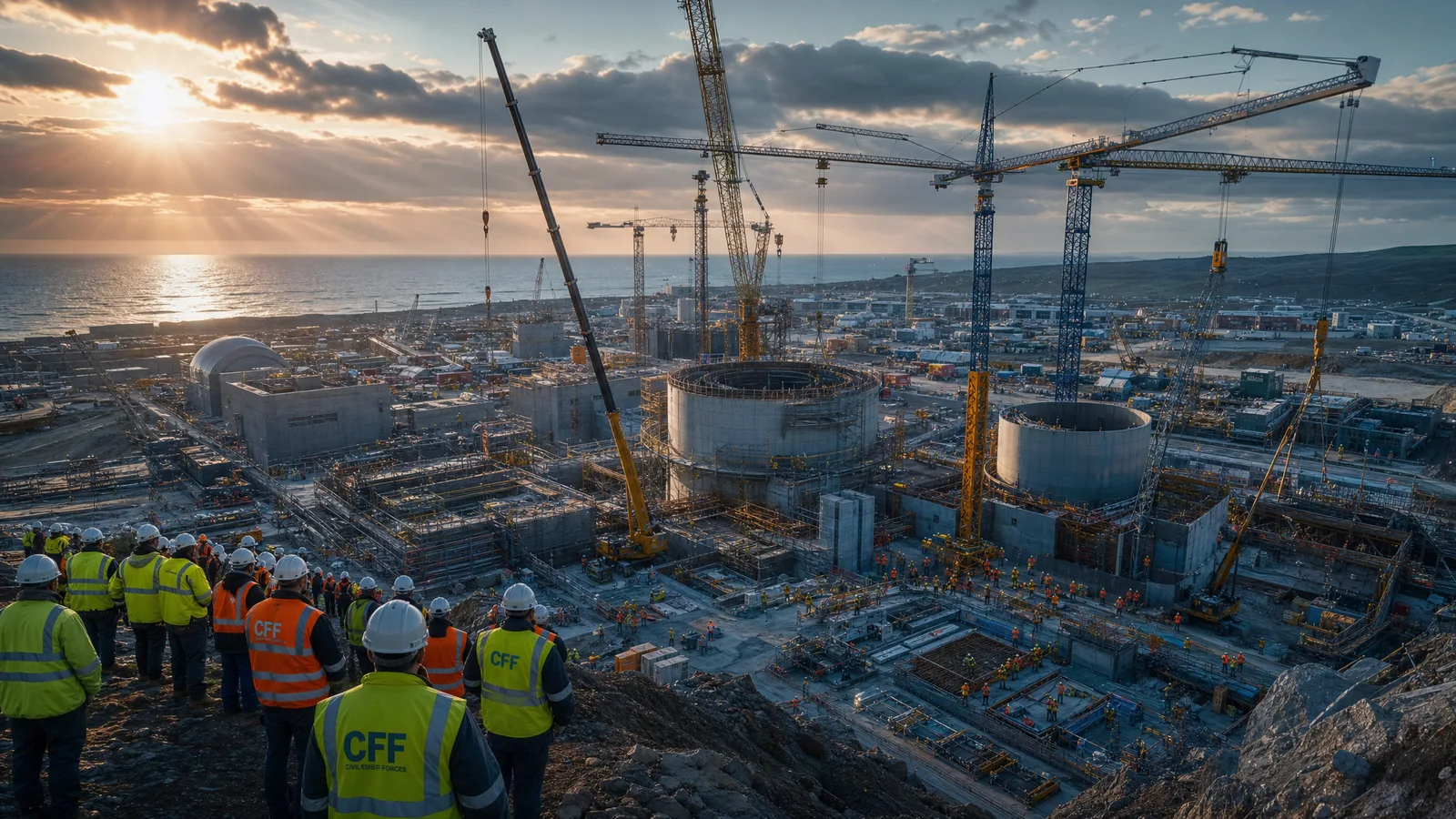
Concept art: CFF mega-site under construction — cathedral-scale infrastructure, built by British workers
CFF Is Built Around These Workers First.
The North Sea is closing. 35,000 of the most highly skilled energy workers in the world are being told their industry is over — with no plan, no alternative, and no transition. CFF was conceived from day one as their answer.
⚙️ Direct Skills Transfer — North Sea → CFF
Subsea wellhead, pressure systems, BOP management
Reactor pressure vessel, primary circuit, safety systems
Offshore pipeline laying, integrity management, cathodic protection
Coastal-to-inland H₂ trunk lines, integrity monitoring, compression stations
High-voltage systems, hazardous area classification, ATEX equipment
High-voltage DC systems, electrolyser stack maintenance, grid tie-in
Offshore construction, seabed surveys, underwater welding
Marine civil works, RO desalination intake/outfall, seabed anchoring
HAZOP, LOPA, SIL assessment, major accident hazard management
ONR safety case, hydrogen ATEX zoning, HTGR fault tree analysis
Shift rotation, remote site management, supply chain, emergency response
24/7 site operations, multi-unit management, national grid coordination
📍 CFF Sites Are Where North Sea Workers Already Live
The Promise to North Sea Workers
"You didn't choose to work in fossil fuels. You chose to work hard, develop world-class skills, and provide for your families. Britain owes you a future — not a redundancy cheque. CFF is that future. Same coast. Same skills. Different system. A future that keeps strategic capability in Britain."
CFF sites are built where North Sea workers live
Direct transfer — no retraining from scratch
Competitive pay bands where required. Pension. Permanent. Public sector.
Not a 5-year contract. A generational institution.
🇬🇧 Britain's Hidden Employment Crisis
These aren't lazy people. They're people in places where the work simply doesn't exist anymore.
🧱 CFF Employs the Entire Skills Spectrum
No other infrastructure project in British history has needed this range — from fruit picker to nuclear engineer, all on the same site.
Where Do ~18,000 Jobs Per Site Actually Come From?
The ~18,000 figure isn’t one number — it’s six categories of employment that span the entire life of a CFF site, from the first survey peg in the ground to the food on your plate 200 years later. Here’s the breakdown.
Phase 2 — Construction & Civil Engineering
The backbone of the build. Earth berms, foundations, reactor buildings, seawater intakes, cooling systems, roads, and the physical infrastructure that will stand for 200 years. Because CFF uses rolling module replacement, construction capability is permanent — there is always a module being installed, refurbished, or replaced.
With 48 modules per site and rolling 60-year replacement cycles, there is never a point where construction stops. These are permanent trades, not temporary contracts.
Phase 3 — Module Installation, Systems & Commissioning
The precision work. Installing factory-built HTGR modules into prepared bays, connecting helium circuits, wiring HTSE electrolyser banks, plumbing desalination systems, and commissioning everything to nuclear-grade standards. This is where North Sea engineering expertise transfers most directly.
Phase 4 — Permanent Site Operations (200 Years)
The beating heart of the site. These are the people who run it — 24/7, 365 days a year, for 200 years. Reactor operators, hydrogen production controllers, water treatment specialists, grid balancers. The roles that make the site produce.
Sellafield currently employs ~11,000 people — and it only decommissions reactors. CFF sites actively produce energy, hydrogen, water, and heat.
The Halo Economy — Spin-Off Industries That Exist Because the Site Exists
This is the part nobody else talks about. Every CFF site produces warm water, oxygen, brine minerals, CO₂-free heat, and surplus electricity. These aren’t waste products — they’re free inputs for entire industries that would be built next to the site to exploit them. The result is a self-contained agricultural and industrial ecosystem that generates thousands of permanent jobs and dramatically reduces Britain’s food import bill.
🐟 Aquaponics & Aquaculture (~1,200 jobs)
Warm water discharge from the HTGR cooling circuit creates ideal conditions for year-round fish farming — salmon, sea bass, prawns — in climate-controlled enclosed systems. The fish waste fertilises hydroponic vegetable beds in the same loop. Zero-waste, zero-import protein production.
🥬 Hydroponics, Vertical Farming & Glasshouses (~1,100 jobs)
Free waste heat and surplus electricity power climate-controlled growing environments year-round. Tomatoes, peppers, leafy greens, herbs, soft fruits — all grown domestically instead of air-freighted from Spain, Kenya, or the Netherlands. Oxygen-enriched atmospheres from HTSE by-products accelerate growth rates.
🏭 Food Processing & Value-Added Manufacturing (~900 jobs)
Raw produce from the farms doesn’t just ship out — it gets processed on-site. Smoked fish, ready meals, freeze-dried goods, packaged salads, juices. Every stage of value-add is a job. Powered by site electricity, heated by site waste heat, stored in site-cooled refrigeration.
🧂 Brine Minerals, Oxygen & Industrial Co-Products (~1,400 jobs)
Desalination produces concentrated brine. Instead of pumping it back to sea, CFF extracts road de-icer salt, magnesium compounds, lithium, and potassium. Oxygen from HTSE goes to hospitals, steelworks, and aquaculture. Nothing is wasted — every by-product becomes someone’s raw material and someone’s job.
Supply Chain, Transport & Heat Halo Network
Every site is a logistics hub. Modules arrive by sea. Hydrogen leaves by pipeline. Produce leaves by road and rail. And 280,000 homes need a maintained district heating network connecting them to the site. These are the jobs that keep everything flowing.
The Heat Halo network alone — connecting ~280,000 homes per site — is a permanent infrastructure requiring dedicated installation teams, maintenance crews, and customer service staff in perpetuity.
Per-Site Employment Summary
These are not temporary construction jobs. The combination of rolling module replacement, permanent operations, and co-located Halo Economy industries means every site is a permanent employer for 200 years. The workforce evolves — surveyors become planners, builders become maintainers, apprentices become directors — but the employment never ends.
💷 The Fiscal Swing — Per Person, Per Year
If a previously workless person moves into a CFF-linked job at around £30K, the public-finance effect can be materially positive — but the exact figure depends on household circumstances, prior benefits, and local spillovers:
Scaled across ~500,000 previously workless or under-employed workers, the aggregate effect could be significant:
🏘️ The Towns That Got Left Behind — Get Built Back Up
CFF mega-sites are deliberately placed in post-industrial Britain. Not in London. Not in the Home Counties. In the places that need them most.
Housing Boom
Workers need homes. Contractors need hotels. Families follow jobs. Every mega-site triggers a local construction and housing market revival.
High Streets Recover
Wages spent locally revive shops, restaurants, and services. Large infrastructure wages usually create a strong local multiplier effect, though the exact ratio varies by region and supply-chain depth.
Schools Improve
Children in stable employed households tend, on average, to have better long-term outcomes. School rolls rise. Attainment rises. The next generation sees a future in their own town.
NHS Pressure Falls
Long-term unemployment is strongly associated with poorer health outcomes. Full employment in a community reduces GP visits, mental health crises, and A&E admissions.
Crime Falls
A town with real work, wages, and purpose is easier to police, easier to govern, and easier to keep stable than a town written off to idleness and decline.
Sellafield Effect
Sellafield became the economic backbone of Cumbria for 70+ years. One state energy site transformed an entire region. CFF does it in more than 20 locations at once.
Built for Generations.
Not the Next Election Cycle.
The cathedral principle is about political time, not a construction calendar. CFF is framed as infrastructure that outlives ministries, parliaments, market cycles, and short-term procurement logic. It is cathedral thinking applied to a modular state-build system: establish the foundation once, then keep extending the asset in disciplined phases over generations.
The Foundation
The first sites prove the model, train the workforce, establish supply chains, and demonstrate that the state can build a repeatable strategic platform. They also create the core site backbone future modules can attach to without tearing up the original design.
National Rollout
The build broadens into a genuine national system. Repetition, standardisation, and accumulated industrial learning lower delivery risk and deepen domestic capability. New capacity is added in repeatable modules, so growth remains orderly, financeable, and sovereignly controlled.
System Maturity
The programme becomes a mature sovereign platform: stronger grid resilience, wider domestic hydrogen use where justified, more stable public-service provision, and deeper industrial integration.
Generational Stewardship
The assets are maintained, upgraded, and governed as permanent national infrastructure. The question is no longer whether they should exist, but how to steward them well for the next generation through maintenance, replacement cycles, and modular expansion where the nation needs more capacity.
🏛️ What Makes a Cathedral Asset?
- ✅ Built to endure — upgraded, extended, and maintained over time rather than treated as disposable infrastructure
- ✅ Strategically embedded — physically anchored in British territory and tied to British public institutions
- ✅ More valuable in crisis — resilience rises when external systems become unstable
- ✅ Publicly directed — pricing, reinvestment, and strategic logic remain sovereign
- ✅ Compounding capability — each decade adds skills, networks, and industrial depth
- ✅ Inherited, not liquidated — the next generation receives assets, not just obligations
📉 What Happens Without Cathedral Thinking?
- ❌ Short-termism — fragmented projects replace national strategy
- ❌ Policy churn — every electoral cycle resets direction
- ❌ Market dependence — strategic essentials remain exposed to external pricing and supply pressure
- ❌ Capability loss — skills and supply chains never fully compound
- ❌ No inheritance — future generations receive weaker systems and higher vulnerability
- ❌ Permanent exposure — one shock after another with no sovereign backbone underneath
The Generational Contract
"We do not build a sovereign system only for ourselves. We build it so the next generation inherits a country that is harder to coerce, harder to shock, and easier to keep running."
Frequently Asked Questions
How many jobs does CFF create?
CFF proposes ~500,000 direct and indirect jobs across 28 mega-sites in construction, operations, engineering, maintenance, aquaculture, food processing, and logistics. With supply-chain and community multiplier effects, the wider employment impact creating the largest back-to-work programme in British history across Britain.
How does CFF help North Sea workers transition?
CFF sites are deliberately placed near North Sea worker communities — Aberdeen, Humberside, Teesside, Great Yarmouth, and the Cromarty Firth. The skills transfer is direct: offshore drilling engineers become HTGR commissioning engineers, subsea pipeline engineers build hydrogen trunk lines, and process safety engineers move into nuclear licensing. Same coast, same skills, different system.
What are the salary ranges for CFF jobs?
CFF spans the entire skills spectrum: entry-level roles (warehouse, catering, security) at £24–27K; semi-skilled (HGV drivers, lab assistants) at £28–36K; skilled trades (welders, electricians) at £35–52K; professional (nuclear operators, chemical engineers) at £42–70K; and leadership (site directors, R&D heads) at £60–110K. All positions are permanent, pensioned public-sector careers.
Where are the CFF mega-sites located?
CFF's 28 mega-sites are deliberately placed in coastal, post-industrial communities across 11 UK regions — from Scotland and Northern Ireland to East Anglia and the South West. Sites are chosen where they can drive regional regeneration, provide local employment, and leverage existing port and energy infrastructure.
By DJ Waugh — Retired Engineer & Creator of Carbon Free Future