Carbon Free Future
✦ A State-Owned National Wealth Engine

Carbon Free Future: A State-Owned National Energy Programme for Britain

28 identical coastal mega-sites — each with 48 HTGR modules in 8 six-packs — delivering green hydrogen, 51 GWe flexible electricity, energy sovereignty, district heating, and 200 years of national resilience for the United Kingdom.

Built by the State. Owned by the People. £425B investment. 8.5-year payback. £2,500B lifetime saving.

Britain Has Done FOAK Before

CFF is a first-of-a-kind national build. But first-of-a-kind does not mean first-impossible. Britain has done this before.

The Victorian sewers. The railways. The town gas conversion. The industrial revolution itself. These were not small upgrades or short-term fixes. They were nation-shaping systems built at scale, under pressure, through doubt, criticism, cost fear, and political resistance — and they still changed the country.

Every major British build worth remembering had doubters. People said it was too big, too expensive, too disruptive, too ambitious, or too difficult to coordinate. Yet Britain built anyway — and the country was stronger for it.

So the real question is not whether CFF is bold. The question is whether modern Britain still has the will to do what earlier Britain did: think long, build properly, and leave behind infrastructure that serves generations rather than patching over decline with one short-term fix after another.

We should call on that tradition again. No more stopgaps. No more managed decline. Do it once. Do it right. Build something worthy of the country.

⚛️
0
HTGR Modules
0 GWe
Flexible Electricity
🔋
0 Mt/yr
Green Hydrogen
👷
0K
British Jobs

What is Carbon Free Future?

A network of 28 identical coastal mega-sites forming a unified national energy infrastructure — delivering hydrogen, electricity, water security, and public dividends. Not just a power station. A National Wealth Engine.

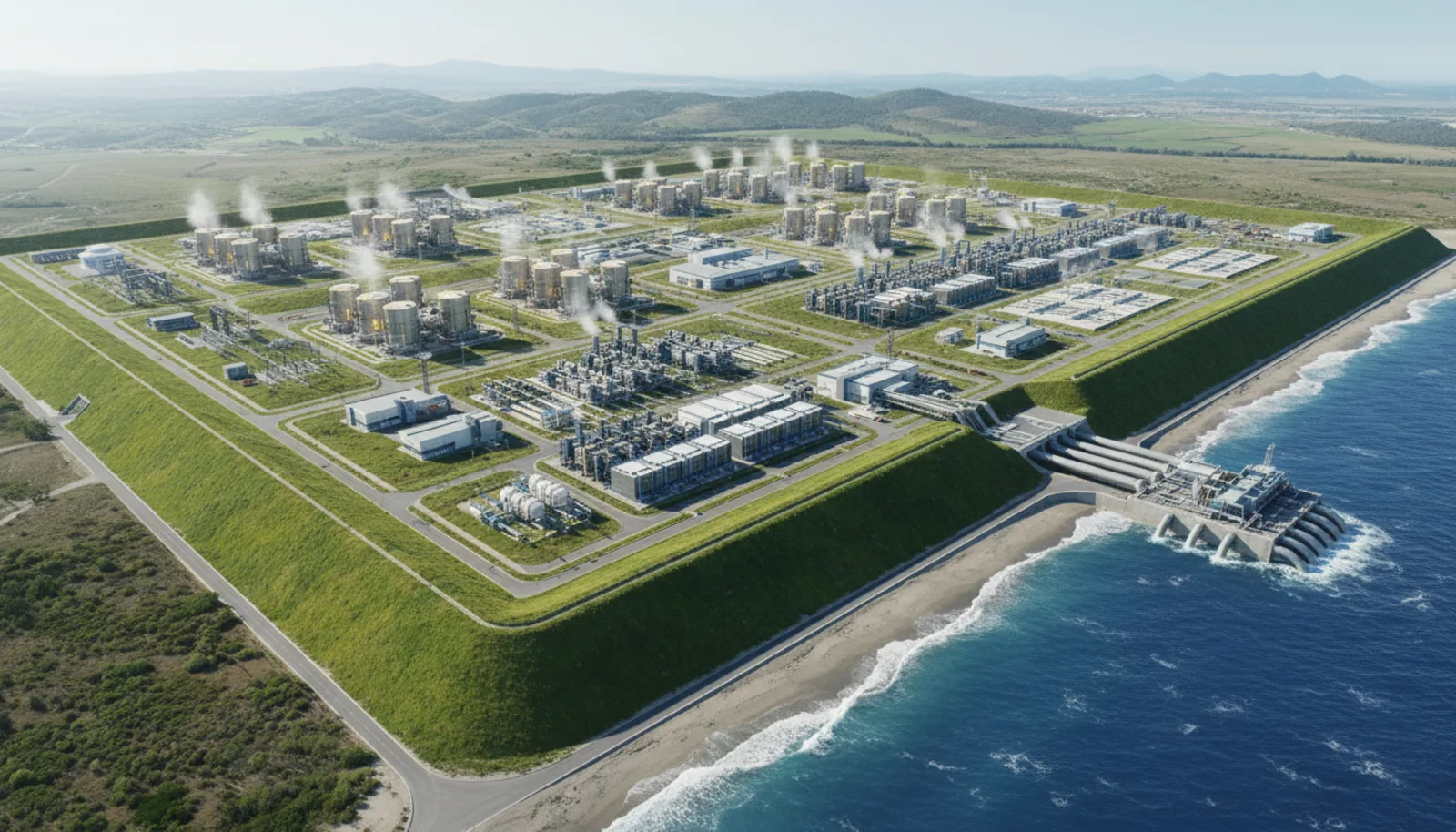
Aerial view of a CFF coastal mega-site showing 48 HTGR modules in 8 six-packs, HTSE hydrogen production complex, desalination plant, and earth berm protection — one of 28 identical sites

Conceptual aerial view of a CFF coastal mega-site — one of 28 identical facilities proposed across the UK coastline

The “Sea-to-Street” Factory

Each CFF site takes in seawater and sends out hydrogen, oxygen, desalinated water, critical minerals, and electricity. It is not just a power station. It is a complete industrial ecosystem.

1,344 identical HTGR modules across the fleet allow UK factories to perfect the manufacturing process, allowing manufacturing methods to standardise and mature over the rollout — the “Fleet Effect.”

“CFF transforms the UK from spending £50B+ per year on imported energy into a fully sovereign energy producer with 200 years of price stability and zero foreign dependency.”

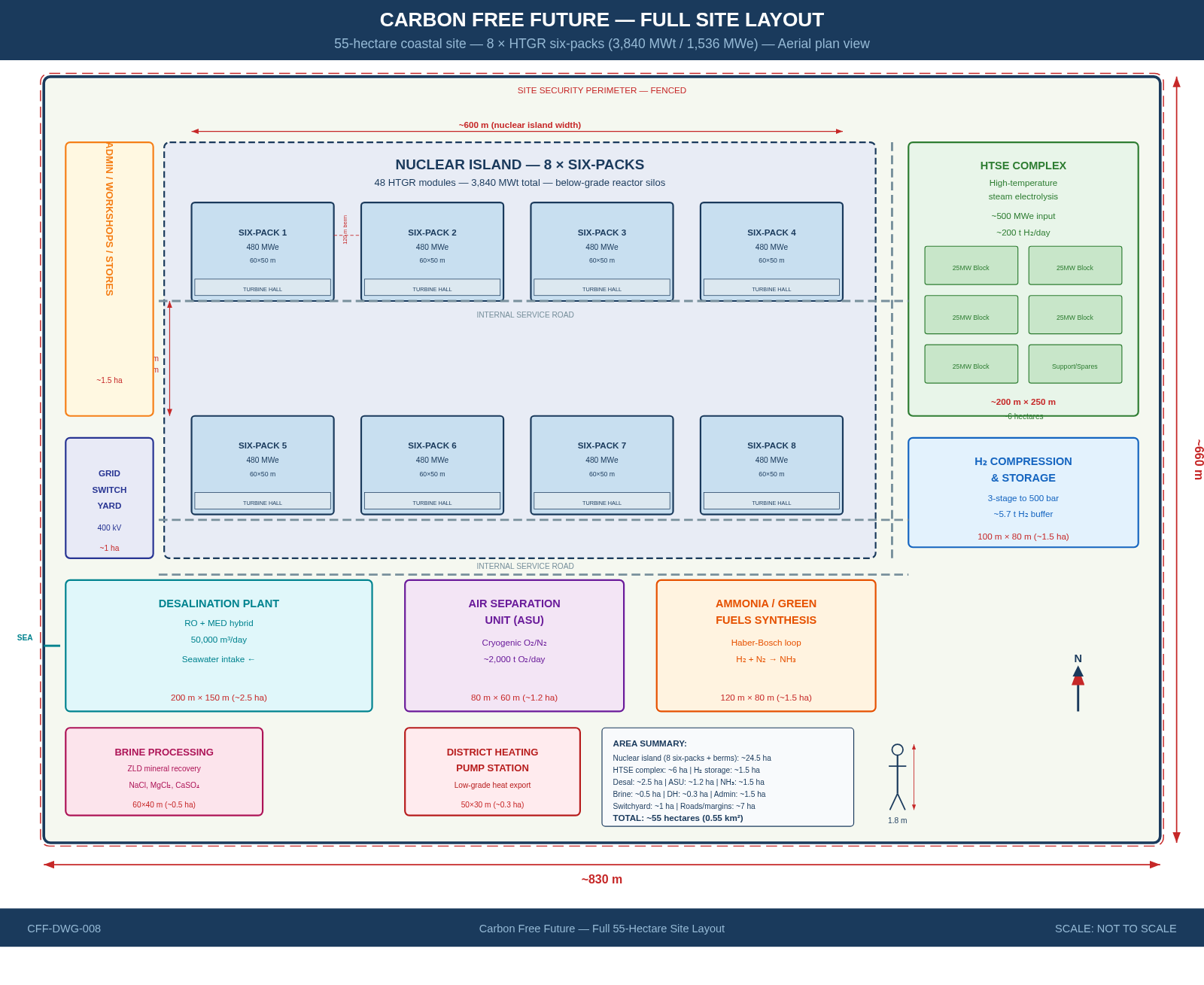
Each CFF site is designed as a modular platform with 48 HTGR modules arranged in 8 self-contained six-packs. Any six-pack can be taken offline for maintenance without affecting the other seven — built-in resilience at the architecture level.

The original CFF concept was based on PWRs, but engineering analysis revealed a fatal flaw: PWRs produce steam at ~285°C while HTSE requires 700–850°C. HTGRs close that gap — helium exits the core at 750°C, producing 700°C steam directly compatible with electrolysers. No parasitic heating. No economic penalty.

Each Mega-Site Produces:

  • ⚛️ 48 HTGR modules (8 six-packs × 6) — 3,840 MWe gross, 3,619 MWe net
  • 🔵 2,072 t/day green hydrogen (44 HTSE banks)
  • +231 MWe surplus electricity exported to grid
  • 💧 50,000 m³/day desalinated water (RO + thermal)
  • 🫁 Oxygen — public services first, industrial surplus sold onward
  • 🧂 Zero-waste brine → road de-icer first, surplus chemical feedstocks sold onward
  • 🔥 District heating via waste heat to surrounding communities
⚛️

48 HTGR Modules per Site

80 MWe / 200 MWth each, arranged in 8 self-contained six-packs. Helium coolant exits the core at 750°C, producing 700°C steam — directly compatible with HTSE electrolysers. Any six-pack can be taken offline without affecting the other seven. 1,344 modules nationally enable true fleet manufacturing.

💧

Desalination

Seawater intake produces HTSE-compatible ultra-pure demineralised water via reverse osmosis (primary) and thermal distillation (using waste heat), plus potable water and a Strategic Water Reserve (50,000 m³/day per site). Each site’s desalination plant can operate independently during drought conditions — ensuring agriculture never fails and crops are always delivered.

🔋

HTSE Electrolysis

44 High-Temperature Steam Electrolysis banks per site split 700°C steam into hydrogen and oxygen at ~40 kWh/kg H₂. The primary purpose of each site — hydrogen production for hard-to-abate sectors, not just electricity. HTGR heat at 700°C goes directly to the electrolysers with no parasitic electrical heating required — the critical advantage over PWR designs. Each site produces 2,072 tonnes/day of green hydrogen.

🧂

Zero-Waste Brine

RO brine is concentrated to ~23% with public service use first: council road de-icer is supplied before any commercial sale. Surplus brine and recovered salts move into chemical feedstocks for chlor-alkali uses, water-treatment chemicals, industrial process salt, and other domestic manufacturing inputs. Nothing goes back to sea.

🔥

District Heating

HTGR waste heat is piped through a district heating model to surrounding communities, reducing heating burden from the Grid and improving local energy resilience. Already proven at scale — Copenhagen’s system serves ~1 million people with over 98% reliability, covering ~98% of buildings in the Greater Copenhagen metro area.

🛡️

120m Earth Berm Protection

15-metre-thick compacted earth berms at 120m separation replace the old 3-mile safety ring. Surface build with equivalent physical protection to underground placement — ~40% cheaper than cavern construction. Proven at Fort St. Vrain (USA), HTR-PM (China), and military installations worldwide. Site footprint: just 0.48 km².

Common Questions

What is Carbon Free Future?

Carbon Free Future (CFF) is a programme to build 28 nuclear-hydrogen sites around the UK coastline, each containing 48 High-Temperature Gas-Cooled Reactor (HTGR) modules producing hydrogen, electricity, and desalinated water from seawater — delivering complete energy sovereignty for 200 years.

How many reactors does CFF propose?

CFF proposes 1,344 HTGR modules across 28 sites (48 per site in 8 six-packs of 6), delivering 51 GWe of flexible electricity and 21.2 Mt/year of green hydrogen — independent of weather and imported fuel.

What does CFF cost and what is the payback?

The programme cost is £425B (central estimate). The UK currently spends £50–80B per year on fossil fuel imports. CFF pays for itself in 8.5 years and delivers £2,500B in lifetime savings over 60 years of operation. The UK spent £183B on energy imports in just 4 years (2021–2024).

Why HTGR instead of PWR reactors?

PWRs produce steam at ~285°C but HTSE electrolysis requires 700–850°C. This 400–500°C temperature gap makes PWR-based hydrogen production thermodynamically impossible at scale. HTGRs use helium coolant at 750°C, producing 700°C steam directly compatible with electrolysers — no parasitic heating required.

Who created Carbon Free Future?

CFF was created by DJ Waugh, a retired engineer, father, and grandfather motivated by a vision to secure the UK's energy future for generations to come. It is an independent proposal with no political or commercial affiliation.

Is CFF a real government programme?

No. CFF is a theoretical framework and policy proposal. It is not affiliated with any government department, political party, or commercial entity. It is presented as a long-range concept for public discussion and consideration.

By DJ Waugh — Retired Engineer & Creator of Carbon Free Future