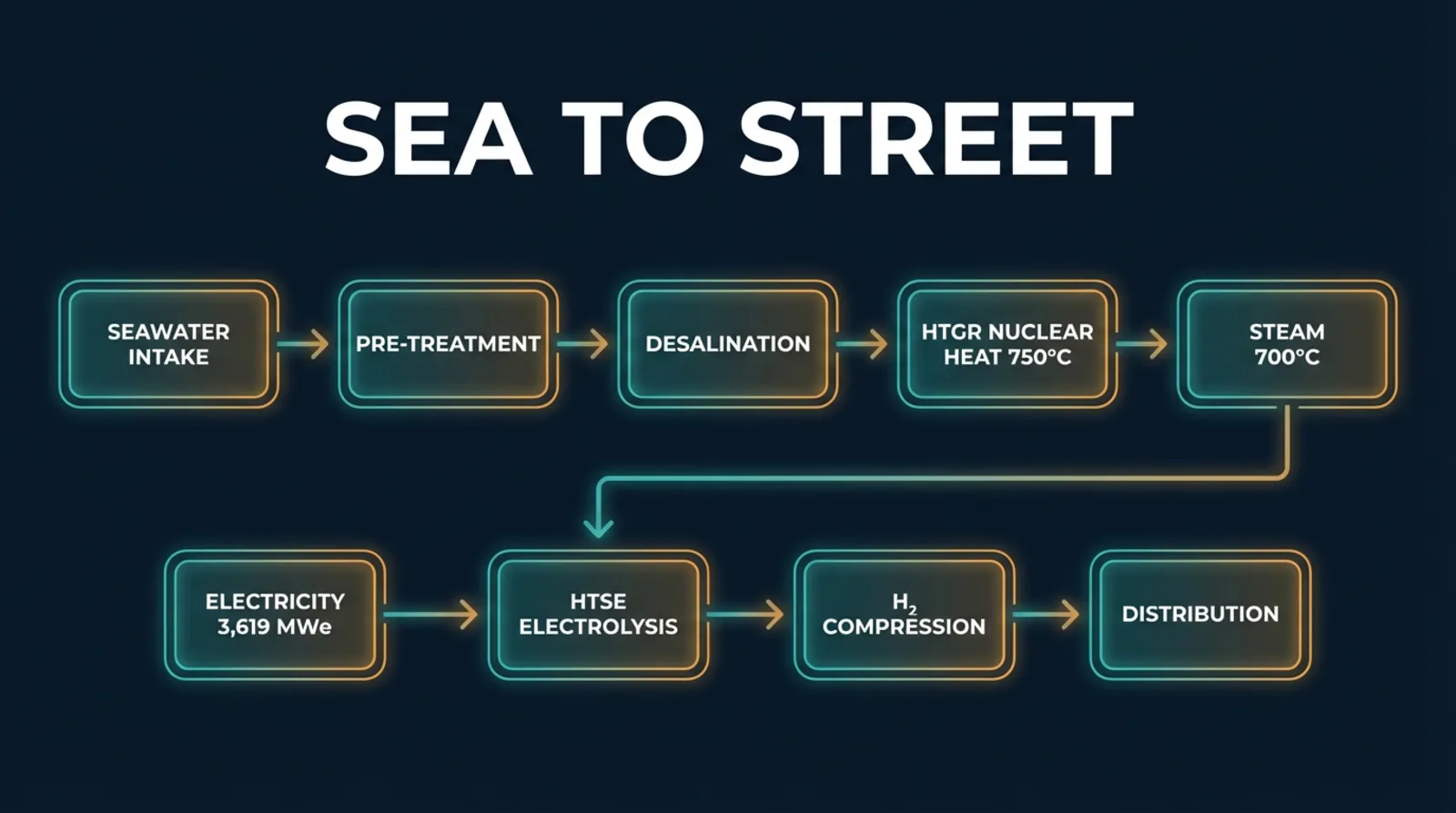
The CFF Sea-to-Street pathway — a zero-waste energy flow from coastal production to community use
Electrification matters, but treating it as the only answer creates pressure on the grid, on industry, and on national resilience. CFF uses electricity where it fits best and reserves hydrogen for the hardest jobs the grid does not solve well on its own.
The CFF Sea-to-Street pathway — a zero-waste energy flow from coastal production to community use
This page uses technical terms from energy engineering. Here is every one of them explained in plain language — no science degree required.
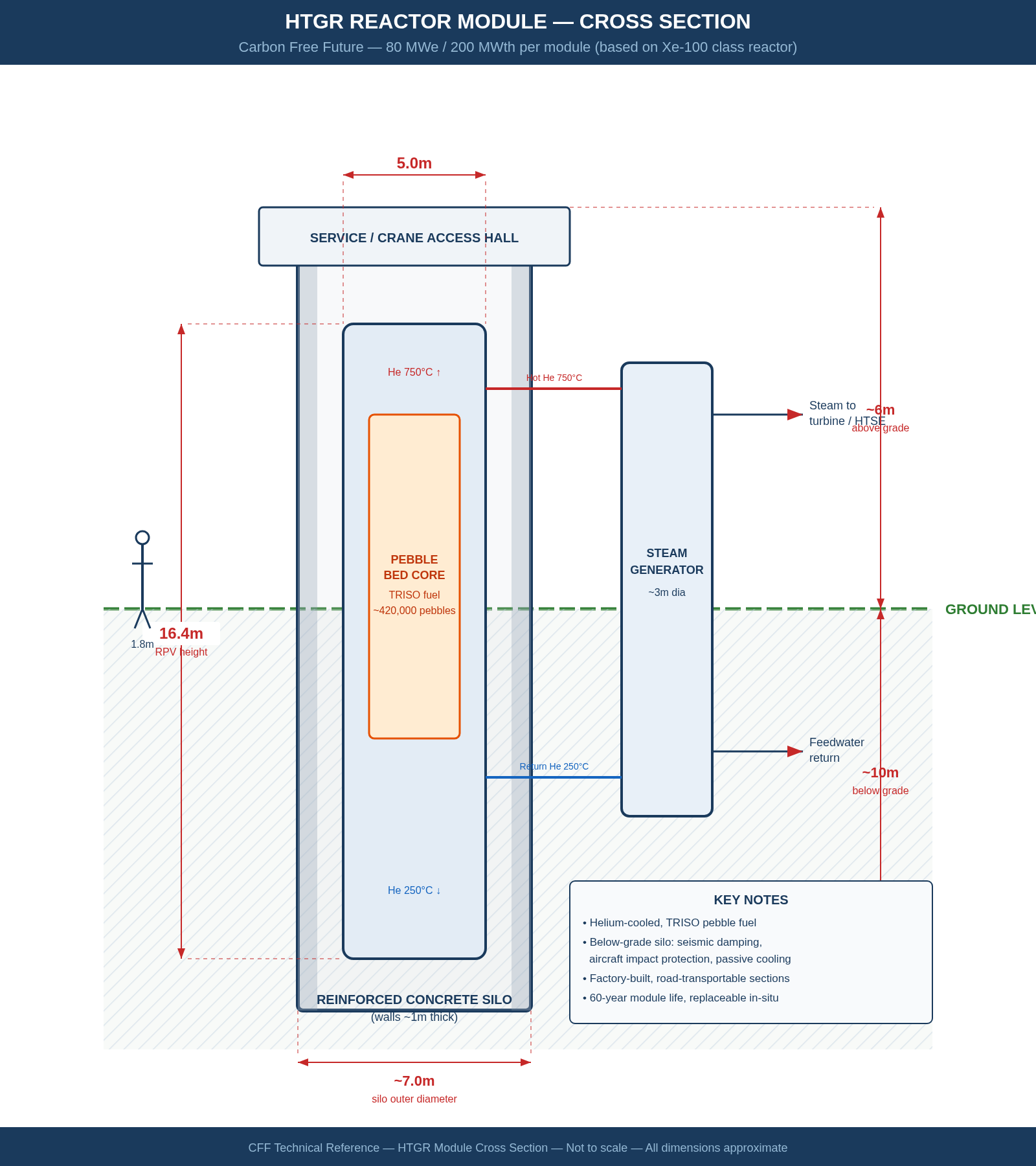
High-Temperature Gas-cooled Reactor. A nuclear reactor that uses tiny fuel pebbles and helium gas instead of water. It runs at about 750 °C — hot enough to boil a kettle six times over. Because helium does not react with anything and the fuel cannot melt down, it is one of the safest reactor designs ever built. China already has one running.
High-Temperature Steam Electrolysis. Imagine passing very hot steam (700 °C) through a device that pulls the hydrogen out and leaves pure oxygen behind. It is like splitting water, but starting with steam so it takes much less electricity. The heat from the HTGR does most of the heavy lifting.
Tri-structural Isotropic fuel. Each fuel particle is a tiny ball of uranium the size of a poppy seed, wrapped in three layers of ceramic armour. These particles are pressed into billiard-ball-sized pebbles. The ceramic layers mean the fuel physically cannot melt — even if every safety system failed, the physics of the fuel itself stops a meltdown.
The gas that carries heat from the reactor core to the steam generators. Helium is chemically inert — it does not corrode pipes, does not become radioactive, and does not explode. It is the same gas used in party balloons, just much hotter.
Gigawatts-electric and Megawatts-electric — units of electrical power. 1 GWe = 1,000 MWe. Each CFF site generates 3.6 GWe (101.3 GWe across all 28 sites) — but under normal operation, every watt is consumed on-site to power HTSE electrolysis (making hydrogen) and desalination. The UK grid is normally run by wind, solar, Hinkley Point C (3.2 GW), and Sizewell C (3.2 GW). Electricity is only sent to the grid when Safe-Flex is activated — each site can ramp HTSE down by 1–50%, freeing up to 1.8 GW per site (~50 GW nationally) as emergency backup.
The lightest element in the universe. When you burn it or run it through a fuel cell, the only waste product is water. CFF uses it as a clean fuel for lorries, heating, and heavy industry — anything that is hard to run on batteries alone.
The process of using electricity (or heat + electricity) to split water into hydrogen and oxygen. CFF does this at 700 °C using HTSE, which is more efficient than room-temperature methods because the steam already has most of the energy needed.
A large landscaped mound of earth built around the site perimeter, typically 15–20 metres high. It acts as a sound barrier, a visual screen, and an additional safety buffer — all at once. From outside, you see a grassy hill, not an industrial complex.
Turning seawater into clean fresh water by forcing it through special membranes that strip out the salt. Each CFF site has four desalination units: one dedicated to hydrogen production, one held as a strategic drought reserve, and two flexible units sized to site-specific needs such as food production or industrial process water. You cannot put salt water through the HTGR cooling circuits or the HTSE electrolysers, so all seawater must be desalinated before it enters the system. The strategic reserve unit sits on standby, activated only when needed — during droughts or to support farmers. Nationally, 28 reserve units = 1.4 million m³/day of emergency fresh water.
The minimum amount of electricity a country needs around the clock — even at 3 a.m. Nuclear reactors are perfect for baseload because they run 24/7 regardless of weather. Wind and solar cannot do this on their own.
CFF's continuous, demand-responsive grid support system — not an on/off switch. Under normal operation, 100% of each site's 3.6 GWe powers hydrogen production (HTSE) and desalination. When renewables underperform, each site can independently redirect anywhere from 0–50% of its capacity to the grid based on real-time local conditions. A south-coast wind lull? Only the local site(s) respond — the rest continue hydrogen production undisturbed. Full-fleet 50% engagement (~51 GWe) is reserved for genuine nationwide system stress such as a Dunkelflaute — and even then, only draws what the grid actually needs. Safe-Flex supports Britain's wind and solar investment during periods of underperformance — it does not replace or compete with it.
The zone within roughly 10 miles of each CFF site where homes receive unlimited heating and hot water for a flat £500 per year. The heat comes from waste warmth the reactors produce anyway — it is essentially free energy that would otherwise be vented. Up to 280,000 homes per site.
A German word meaning "dark doldrums" — a weather event where there is no wind and no sunshine for days or weeks. It is the worst-case scenario for renewable energy. CFF's nuclear backbone means Britain keeps running through a Dunkelflaute without blackouts.
Enormous underground chambers carved out of natural salt deposits, used to store hydrogen at high pressure. Britain has some of the best salt geology in Europe — particularly in Cheshire and East Yorkshire. A single cavern can hold enough hydrogen to power thousands of homes for months.
The cost savings that come from building the same design over and over. The first site costs the most. By site 5 or 10, every contractor knows the blueprint, supply chains are established, and construction time drops. This is why CFF commits to 28 identical sites — the more you build, the cheaper each one gets.
First-Of-A-Kind and Nth-Of-A-Kind. FOAK is the expensive first build where you learn all the lessons. NOAK is the later builds when costs have fallen because the design is proven, the workforce is trained, and the supply chain is mature. CFF's ~£15 billion per-site figure is the series-production target for a complete six-output site once UK factories are established. The first few sites use imported reactor modules while UK manufacturing capacity is built in parallel.
Still confused by something? Drop us a message and we will add it to this glossary.
CFF did not pick these technologies at random. Every component was chosen because it beats the alternatives on safety, efficiency, temperature, or proven track record — or all four. Here is the head-to-head case for each choice.
CFF needs a reactor that can deliver 750 °C heat directly to steam electrolysers. That single requirement eliminates most of the competition before the conversation starts.
| Reactor Type | Outlet Temp | Efficiency | Why CFF Ruled It In/Out |
|---|---|---|---|
| HTGR (Pebble Bed) ✓ | 750–950 °C | 40–50% | Delivers 750 °C helium directly — hot enough for HTSE without any parasitic electrical heating. TRISO fuel is meltdown-proof. China’s HTR-PM is already operating. The only proven reactor that gives CFF what it needs at the right temperature. |
| PWR (Pressurised Water) | ~324 °C | 30–35% | Steam at 285 °C is 465 °C too cold for HTSE. Would need 60–70% of electrical output just to heat steam up to operating temperature — destroying the efficiency argument. Hinkley Point C is a PWR. It costs £35 billion for 3.2 GWe and produces only electricity. |
| BWR (Boiling Water) | ~288 °C | 30–34% | Even colder than a PWR. Same fundamental problem — steam is far too cool for efficient electrolysis. Also runs at high pressure with water as both coolant and moderator, meaning the reactor pressure vessel must be massive. |
| Molten Salt Reactor | 700–850 °C | 42–50% | Reaches the right temperatures — but no commercial MSR has ever been built. The only demonstration (Oak Ridge, 1960s) ran for 4 years. Molten fluoride salts are highly corrosive above 700 °C, requiring exotic alloys that have not been validated at scale. Regulatory pathway is 25–30 years behind HTGRs. Promising technology for the future, but not ready for a programme starting this decade. |
Bottom line: HTGR is the only reactor type that is hot enough, proven enough, and safe enough to start building this decade. China’s HTR-PM reached grid connection in 2023. No PWR, BWR, or MSR can match that combination today.
All three technologies split water into hydrogen and oxygen. The difference is how much electricity they need to do it — and that comes down to temperature.
| Electrolyser | Temperature | Efficiency | Why CFF Ruled It In/Out |
|---|---|---|---|
| HTSE (Solid Oxide) ✓ | 700–850 °C | ~84% electrical | Takes 700 °C steam directly from the HTGR’s helium loop. The heat does most of the work, so the electrolyser needs far less electricity. Also produces pure oxygen as a sellable co-product. The whole CFF efficiency argument depends on this pairing — HTGR heat + HTSE electrolysis = more hydrogen per unit of energy than any other combination. |
| PEM (Proton Exchange Membrane) | 50–80 °C | 67–75% (LHV) | Runs at room temperature — all energy must come from electricity. Needs expensive platinum and iridium catalysts. Excellent for wind/solar coupling where power fluctuates, but wasteful when you have 750 °C heat already available for free. Also shorter lifespan (~60,000–80,000 hours vs 80,000–100,000 for HTSE at scale). |
| Alkaline | 60–90 °C | 65–72% (LHV) | The oldest and cheapest electrolyser — but also the least efficient. Slow to start up, slow to respond to load changes. No ability to use the HTGR’s waste heat. Produces lower-purity hydrogen. Proven at scale for industrial use, but fundamentally the wrong tool when 700 °C steam is sitting right next door. |
Bottom line: When you have a reactor producing 750 °C heat, using a room-temperature electrolyser is like boiling a kettle then waiting for it to cool down before making tea. HTSE uses the heat directly. That is the entire efficiency advantage — and it only works because the HTGR provides the temperature that PEM and alkaline cannot use.
Conventional nuclear fuel rods use uranium dioxide (UO₂) pellets stacked inside zirconium alloy tubes. They work — but they have a fundamental weakness that TRISO eliminates.
Bottom line: TRISO fuel is more expensive to manufacture (~$30,000/kgU vs ~$2,500/kgU for standard UO₂). But it eliminates the possibility of a meltdown at the fuel level — not through safety systems, not through human operators, but through the physics of the fuel itself. For a programme placing 28 sites across Britain, that level of inherent safety is non-negotiable.
This is not a marketing claim. It is the conclusion of decades of testing by national laboratories, independent reviewers, and Generation IV safety assessments across four continents.
TRISO particles withstand temperatures above 1,600–1,800 °C without releasing significant radioactive material. Traditional light-water reactor fuel begins to fail at far lower temperatures. In testing, TRISO survived up to ~1,800 °C — well beyond any credible accident scenario.
HTGRs remove decay heat passively through conduction and radiation alone — even in a complete loss of coolant or loss of forced cooling. No active systems, no electricity, no operator action is required to prevent core damage. The reactor simply cools itself down.
Each poppy-seed-sized TRISO particle is its own miniature pressure vessel — three layers of carbon and silicon carbide containing fission products. Even if the reactor vessel or other systems fail, the particles themselves largely contain the radioactivity.
Decades of irradiation and accident-condition testing across the US AGR programme, German pebble-bed programmes, the Chinese HTR-10, and now the HTR-PM have shown very low fission-product release even under simulated worst-case scenarios.
The U.S. Department of Energy states that TRISO particles “cannot melt in a commercial high-temperature reactor” and outperform traditional fuels in irradiation resistance, corrosion resistance, oxidation resistance, and high-temperature performance. Reactor vendors, independent reviews, and Generation IV assessments all highlight HTGRs’ strong safety characteristics compared with conventional light-water reactors — especially regarding meltdown resistance.
Note: “The safest” depends on specific criteria — probability of release, accident consequences, operational experience. Other advanced concepts (molten-salt reactors, certain microreactors) also claim very high safety levels. But across the full range of criteria, HTGRs with TRISO are broadly viewed by experts, national laboratories, and industry as one of the safest reactor technologies developed to date. CFF chose this combination because placing 28 sites across populated coastal Britain demands nothing less than the best safety record available.
Most nuclear reactors in the world use water as coolant. It works. But CFF needs something that can carry heat at 750 °C without corroding every pipe it touches or becoming radioactive in the process.
Helium is stable at any temperature a nuclear reactor can produce. Water turns to superheated steam above 374 °C and cannot carry heat at the temperatures HTSE needs without extreme pressure and corrosion.
Helium is a noble gas. It does not react with reactor components, does not corrode pipes, and does not degrade over time. Water-cooled reactors face constant corrosion management, especially at high temperatures.
When neutrons hit water molecules, they produce radioactive tritium (hydrogen-3) and oxygen-16 activation products. Helium has an extremely low neutron absorption cross-section — it stays clean, simplifying maintenance and reducing waste.
Water-cooled reactors risk generating explosive hydrogen if zirconium cladding overheats (Fukushima, Three Mile Island). Helium-cooled + TRISO-fuelled reactors eliminate both the water and the zirconium — removing both ingredients for a hydrogen explosion.
Bottom line: Helium is the only coolant that lets the reactor reach 750 °C safely, stays completely inert, does not become radioactive, and removes two of the three conditions for a nuclear hydrogen explosion. It is the reason an HTGR can sit next to a housing estate behind an earth berm — the physics simply do not allow the kind of accident that made Fukushima and Chernobyl household names.
Nothing works without desalination. Seawater is drawn into the site, but you cannot put salt water through HTGR cooling circuits or HTSE electrolysers — salt corrodes equipment, fouls membranes, and contaminates hydrogen output. So the very first step in the CFF process is desalination: turning raw seawater into ultra-pure fresh water before it enters anything else.
One unit is dedicated to hydrogen production, producing the ultra-pure feedwater the HTSE electrolysers need. Two flexible units are sized to site-specific needs — cooling water for the HTGR modules, process water for on-site systems, and committed industrial or food-production capacity such as a semiconductor fab or an aquaculture campus — with built-in headroom so a heavier-demand site never needs a costly retrofit. Without these three units, the site cannot function.
The fourth unit is the strategic reserve. It does not feed the internal system and is never committed to routine daily use elsewhere on-site, so it remains a genuine reserve rather than capacity already spoken for. It exists solely as a strategic water reserve — activated only when needed: during droughts, water shortages, or when farmers need irrigation support. Each reserve unit produces 50,000 m³/day of fresh water. Across 28 sites nationally, that is 1.4 million m³/day of emergency fresh water on standby.
CFF chose reverse osmosis (RO) because it needs only electricity (which the HTGR produces in abundance) and uses 3–4 kWh per cubic metre — roughly 10× less energy than thermal distillation at 38 kWh/m³. RO membranes are commercially proven at scale worldwide, with well-understood maintenance cycles.
The system flow: Seawater in → Desalination first (the hydrogen unit plus two flexible units) → Ultra-pure water feeds HTGR cooling + HTSE electrolysis → Hydrogen and oxygen out. The strategic reserve unit sits alongside, held apart for public water emergencies. Nothing enters the reactor or electrolyser system until the salt is removed.
These technology choices are not independent. They form an interlocking chain where each component enables the next:
Swap the HTGR for a PWR → steam drops to 285 °C → HTSE cannot work efficiently → you lose 30–40% of the hydrogen output
Swap HTSE for PEM → you waste 750 °C of free heat → every kilogram of hydrogen costs more electricity
Swap helium for water → you cannot reach 750 °C without extreme pressure → corrosion and activation products multiply
Swap TRISO for conventional fuel → you lose the meltdown-proof physics → you need massive containment structures → cost escalates
Every piece depends on the piece before it. Change one component and the efficiency, safety, or economics of the entire chain falls apart. That is not a design weakness — it is engineering precision. The reason CFF specifies these exact units is because no other combination delivers 750 °C heat, meltdown-proof fuel, non-radioactive coolant, and 84%-efficient electrolysis in a single integrated system.
“Why not just use wind and solar with batteries?” — Fair question. Here is the honest answer, worked through with real numbers that anyone can check.
The UK consumes an average of ~30.7 GW of electricity continuously (DESNZ, 2024 data — 319 TWh/year). On a cold, dark January evening, demand spikes to ~45–50 GW. A serious national battery must cover the worst case, not the average.
Utility-scale lithium-ion battery storage costs $150–$250/kWh installed (NREL 2025 benchmark, Ember Energy, VIP Energy Service). Using the midpoint of $200/kWh:
| Scenario | Energy Needed | Cost @ $200/kWh | Cost in £ |
|---|---|---|---|
| Average demand (30.7 GW × 14 days) | 10,300 GWh | $2.06 trillion | ~£1.6 trillion |
| Winter peak (45 GW × 14 days) | 15,100 GWh | $3.02 trillion | ~£2.4 trillion |
The entire CFF programme — 28 sites, 200 years of energy, 500,000+ jobs — costs £425 billion. A 2-week national battery would cost £1.6 to £2.4 trillion — roughly 4 to 6 times more — and would need replacing every 10–15 years. CFF lasts 200 years.
A 10,300 GWh battery does not just cost money. It requires physical materials that come out of the ground. Here is what the mining industry would need to deliver — for one country’s battery, not the whole world’s:
| Material | Needed for 10,300 GWh | Global Reserves | % of World Reserves | Verdict |
|---|---|---|---|---|
| Lithium Metal | ~1,650,000 tonnes | ~28 million tonnes (USGS 2024) | ~5.9% | Nearly 6% of all known lithium on Earth — for one country |
| Cobalt (if NMC chemistry) | ~1,030,000 tonnes | ~12 million tonnes (USGS 2025) | ~8.6% | Nearly 9% of global cobalt — most from the Congo |
| Nickel (if NMC chemistry) | ~7,200,000 tonnes | ~130 million tonnes | ~5.5% | More nickel than the UK mining industry has ever produced |
| Graphite (anode material) | ~10,300,000 tonnes | ~320 million tonnes | ~3.2% | China controls 65% of global graphite supply |
| Total battery weight | ~62 million tonnes (cells + structure) | Equivalent to the weight of ~620 aircraft carriers | ||
Note on LFP chemistry: Lithium iron phosphate (LFP) batteries avoid cobalt and nickel but still require the same lithium and even more iron. They also have lower energy density (~120 Wh/kg vs ~250 Wh/kg for NMC), meaning the battery would be roughly twice as heavy — over 100 million tonnes of physical material.
The numbers above are for one country. Now imagine every major economy — the US, Germany, France, Japan, India, China — each needing their own 2-week battery. The materials simply do not exist on Earth at that scale.
Utility-scale battery installations need 600–1,000 sq ft per MWh once you include the battery containers, inverters, transformers, cooling systems, fire safety setbacks, and access roads (Convergent Energy, TerraPro Solutions). For our 10,300 GWh battery:
| Metric | Conservative (600 sq ft/MWh) | Upper End (1,000 sq ft/MWh) |
|---|---|---|
| Total area | ~574 km² (142,000 acres) | ~957 km² (236,000 acres) |
| Football pitches | ~80,800 | ~134,800 |
| Comparison | Bigger than the Isle of Man (572 km²) | Roughly the area of Greater Manchester (630 km²) to the West Midlands (902 km²) |
To visualise it: imagine laying out football pitches side by side in a grid. At the conservative end, you’d fill over 80,000 pitches — enough to tile every single football ground in England, Scotland, Wales, and Northern Ireland hundreds of times over. This isn’t a farm tucked behind a substation. It’s an industrial zone larger than a county, fenced, climate-controlled, and patrolled — consuming some of Britain’s most contested resource: land.
Building the battery is only half the problem. You still have to fill it with electricity — and the numbers here are just as brutal.
Lithium-ion batteries have a round-trip efficiency of ~85–90% (NREL, Sunlit Energy). That means to store 10,300 GWh of usable energy, you need to generate approximately ~12,100 GWh of electricity — the missing ~1,800 GWh is lost as heat during charging.
| Charging Scenario | Power Dedicated | Time to Charge | What That Means |
|---|---|---|---|
| All UK generation capacity | 72 GW | ~7 days | Lights off for every home, hospital, factory for a week |
| All UK renewables output | ~16.5 GW avg* | ~31 days | Every wind turbine & solar panel in Britain feeds nothing but the battery for a month |
| A realistic spare capacity | ~10 GW | ~50 days | Nearly 2 months of constant charging — then hope nothing breaks |
* UK wind + solar generated ~98 TWh in 2024 (DESNZ DUKES 2025) = average output of ~16.5 GW across the year, despite ~61 GW nameplate capacity (capacity factors: wind ~25–40%, solar ~10%).
The Circular Problem: To charge a battery big enough for 2 weeks of backup, you need to generate 2 weeks’ worth of electricity on top of normal demand. That means you’d need to roughly double the UK’s entire generation capacity — build another 72 GW of power stations — just to have surplus power to fill the battery. And those extra power stations need to be reliable enough to produce on demand… which is exactly the problem batteries were supposed to solve.
One full charge of this battery would consume 12.4% of the UK’s entire annual wind and solar output (12,100 GWh out of 98 TWh). If the battery drained and needed refilling multiple times a year — as a genuine backup system would — you’d need to build vast new generation capacity that doesn’t yet exist, at a cost measured in hundreds of billions more.
Even if you could build this battery and somehow source the materials, lithium-ion batteries degrade with every charge cycle. Grid-scale batteries have a useful lifespan of 10–15 years before they need replacing. That means:
| Infrastructure | Cost | Lifespan | Replacements in 200 Years | Total Lifetime Cost |
|---|---|---|---|---|
| 2-Week National Battery | ~£1.6 trillion | 10–15 years | 13–20 full replacements | £21–32 trillion |
| CFF (28 sites) | ~£425 billion | 200 years (rolling replacement) | 0 (modular refurbishment) | ~£425 billion |
Over 200 years, a battery-only approach would cost £21 to £32 trillion in replacements alone — roughly 50 to 75 times the cost of the CFF programme. And that is before you account for the mining, refining, transport, and recycling of tens of millions of tonnes of battery materials every decade.
Batteries are excellent for short-duration balancing — smoothing out a few hours of solar dip or absorbing an overnight wind surplus. Nobody is arguing against batteries for those jobs. But asking batteries to replace baseload power generation for weeks at a time is a fundamentally different proposition, and the numbers do not survive contact with reality:
4–6× the cost of the entire CFF programme — and that is just the first battery
6% of all known lithium on Earth — for one country, for one battery, for one decade
62 million tonnes of physical material — the weight of 620 aircraft carriers
Full replacement every 10–15 years — 200-year cost: £21–32 trillion
27× the entire world's current battery capacity — and every other country needs theirs too
CFF does not need a 2-week battery because the reactors never stop generating. They run 24/7, through winter, through Dunkelflaute, through every dark windless night. Under normal operation, all 3.6 GWe per site powers hydrogen production and desalination — the UK grid is run by wind, solar, plus Hinkley Point C (3.2 GW) and Sizewell C (3.2 GW). When renewables fail and Britain needs emergency backup, Safe-Flex activates: HTSE ramps down by anything from 1% to 50%, freeing up to 1.8 GW per site for the grid. Scale that across all 28 sites and Britain has up to ~50 GW of firm nuclear backup on demand — without needing a single battery. The moment renewables recover, HTSE ramps back to full load. Stored hydrogen in salt caverns covers any interim industrial demand, measured in months, not hours. That is the difference between an energy system that needs an impossibly large battery and one that simply does not need one at all.
If heat, transport, freight, and industry are all forced onto the same power system, the UK must overbuild generation, substations, transmission, storage, and balancing capacity at enormous scale. The problem is not just clean generation. It is the speed, cost, and physical burden of rebuilding the whole system at once.
The hardest test is not an average day. It is cold, dark, low-wind winter conditions when heating demand surges and resilience matters most. A strategy that concentrates too much national demand into those hours raises pressure exactly where failure would hurt most.
Steel, fertiliser, chemicals, refining replacement, and high-temperature industrial heat are not solved by plugging everything into the wall. Parts of the economy still require hydrogen as fuel, feedstock, or process input if Britain wants to decarbonise without hollowing out industry.
HGV corridors, depot fleets, and long-haul freight are not the same problem as private cars. Turnaround speed, vehicle utilisation, payload, route certainty, and depot logistics all matter. A national freight strategy needs room for hydrogen where operational reality favours it.
An all-electric pathway does not automatically create sovereignty. If the UK remains dependent on imported components, foreign processing chains, and concentrated manufacturing overseas, the vulnerability remains. The dependency has simply moved upstream.
A serious national system does not rely on a single vector for every task. Electricity should carry a great deal of the load, but resilience improves when hydrogen is held for strategic uses where stored molecules strengthen industrial continuity, freight resilience, and system backup.
CFF makes the hydrogen case tighter and more credible. Hydrogen is not treated as a universal answer. It is directed where it adds the most strategic value and where electrification alone leaves a gap. At 704 TWh/yr, CFF produces far more hydrogen than Britain needs domestically — and that surplus is a sovereign strategic asset.
Steel, fertiliser, chemicals, refining replacement, and high-temperature industrial heat are not solved by plugging everything into the wall. Parts of the economy still require hydrogen as fuel, feedstock, or process input if Britain wants to decarbonise without hollowing out industry. Estimated domestic demand: ~232 TWh/yr (33% of CFF output).
Hydrogen priority goes to HGVs, high-utilisation freight corridors, depot-based logistics fleets, shipping-linked freight operations, and other heavy-duty applications where range, payload, uptime, and refuelling speed matter. Estimated domestic demand: ~99 TWh/yr (14% of CFF output).
A fixed 10% of total production is held back as a strategic reserve — stored in salt caverns and underground formations to cover prolonged low-wind events, industrial contingencies, and grid-stress situations. This reserve is never sold or exported. It is the national insurance policy. Allocation: ~70 TWh/yr.
After covering every tonne of domestic demand and holding 10% back as an untouchable strategic reserve, CFF still has ~303 TWh/yr of sovereign hydrogen surplus. That is not waste. That is a national competitive weapon.
Total: ~704 TWh/year | Domestic demand covered first, then a sovereign surplus emerges for export, synthetic fuels, and strategic economic advantage
CFF reserves hydrogen for the areas where the national system gains the most from it: industrial heat, industrial feedstocks, steel, chemicals, fertiliser, refining replacement, heavy goods transport, and a fixed 10% strategic reserve that is never sold or exported.
At 704 TWh/yr, domestic demand only accounts for roughly 57% of CFF’s capacity. The remaining 43% is not a planning error. It is a sovereign surplus that gives Britain options no other country has.
Hydrogen is not for everything. It is for the hardest jobs first. British hydrogen for industry. British hydrogen for freight. Strategic reserve held back for national insurance. And the surplus? That is sovereign leverage — exported, converted, or used to attract industry that no other country can offer cheaper clean energy to.
After every domestic need is met and the strategic reserve is filled, CFF still produces roughly 303 TWh/yr of green hydrogen with nowhere mandatory to go. That surplus is not a problem. It is the most powerful economic instrument a state can hold in the 2030s energy market. Here is what it enables:
Pipeline hydrogen to Europe via interconnectors. The EU’s hydrogen import targets are enormous and growing. Britain becomes a net energy exporter for the first time in decades — but selling molecules, not burning fossil fuels. Revenue flows back to the Treasury, not to shareholders.
Green hydrogen + captured CO₂ = synthetic kerosene. Heathrow alone consumes ~6 million tonnes of jet fuel per year. CFF surplus can supply a domestic SAF industry, cutting aviation emissions and eliminating the need to import synthetic fuel at premium prices.
Ammonia (NH₃) is the backbone of global fertiliser and a leading candidate for shipping fuel. Britain currently imports virtually all of its ammonia. CFF surplus can produce green ammonia domestically — securing the food chain and creating an export commodity.
The cheapest green hydrogen in Europe attracts energy-intensive industry that other countries cannot compete for. Steelmakers, chemical processors, data centres, and advanced manufacturers relocate to where the energy is cheapest and greenest. CFF surplus becomes an industrial gravity well.
Surplus hydrogen stored in salt caverns can be converted back to electricity through hydrogen turbines during extreme grid events — providing a second layer of grid insurance beyond Safe-Flex. Stored energy that does not depend on wind, sun, or batteries.
Britain’s ports become green bunkering hubs. Ships refuel with hydrogen or hydrogen-derived ammonia at UK ports instead of fossil bunker fuel. Port revenue increases. Shipping emissions drop. Britain leads the maritime energy transition.
Most countries are scrambling to produce enough hydrogen to meet their own domestic needs. CFF gives Britain a position where domestic demand is covered, the strategic reserve is full, and there is still enough surplus left over to export, convert into aviation fuel, manufacture ammonia, attract heavy industry, or store as a second grid insurance layer. That is not overproduction. That is sovereign energy leverage — and no other nation on Earth has it at this scale.
The 43% surplus is not idle capacity. When directed into domestic heating and personal transport, it removes the majority of homes and cars from grid dependency — collapsing the “electrify everything” load before it ever lands on the national grid.
Britain has roughly 28 million homes. The Heat Halo already removes 7.84 million from the equation — unlimited heating and hot water for a flat £500/year, no grid load, no gas boiler. The remaining 20.16 million are split between electric heat pumps for newer, well-insulated stock and hydrogen boilers for the vast majority of older, harder-to-retrofit homes.
| Segment | Homes | Method | Grid Load |
|---|---|---|---|
| Heat Halo | 7.84M | £500/yr — unlimited heat | Off-grid |
| ASHP (30%) | ~6.05M | Electric heat pump | On-grid |
| H₂ Boiler (70%) | ~14.11M | Hydrogen combustion | Off-grid |
H₂ demand: 14.11M homes × ~15,900 kWh/yr = ~224 TWh/yr
Result: 21.95 million homes (78%) need nothing from the electrical grid for heating. Only 6.05M remain grid-dependent for heat.
Britain has roughly 33 million cars. BEVs suit short urban driving and well-charged suburban use. Hydrogen fuel cells suit motorway commuters, long-haul drivers, and anyone who needs range and rapid refuelling without grid dependency. The 40/60 split reflects real-world driving patterns.
| Segment | Vehicles | Fuel | Grid Load |
|---|---|---|---|
| BEV (40%) | ~13.2M | Battery electric | On-grid |
| H₂ FCEV (60%) | ~19.8M | Hydrogen fuel cell | Off-grid |
H₂ demand: 19.8M cars × ~4,100 kWh/yr = ~81 TWh/yr
Result: 19.8 million cars (60%) removed from grid charging demand entirely.
| H₂ Use | TWh/yr |
|---|---|
| Domestic heating (14.11M H₂ boilers) | ~224 |
| Personal transport (19.8M FCEVs) | ~81 |
| Total H₂ required | ~305 |
| Sovereign surplus available | ~303 |
| Gap | ~2 TWh (<1%) |
A gap of less than 1% is a rounding error at national scale. It falls comfortably within the margin covered by seasonal efficiency variation, minor ratio adjustment, or a fractional draw on the 70 TWh strategic reserve.
removed from grid heating demand
(Heat Halo + H₂ boilers = 21.95M homes)
removed from grid charging demand
(19.8M hydrogen fuel cell vehicles)
Under a pure electrification strategy, the national grid must power 28 million heat pumps and charge 33 million electric vehicles — simultaneously, through winter peaks, through cold snaps, through every dark windless evening. Under the CFF model, the grid only serves ~6 million ASHPs and ~13 million BEVs. The hydrogen economy absorbs the rest. That is not a marginal adjustment. It is a fundamental reduction in the infrastructure the grid has to carry.
Hydrogen boilers do not draw evenly across the year. Roughly 80% of a home’s gas use is space heating — concentrated almost entirely in winter. In summer, demand drops to hot water only. That seasonal swing is not a weakness. It is an advantage built into the physics of the system.
| Period | Months | H₂ Demand (Homes) | Monthly Rate | Car Demand (Flat) |
|---|---|---|---|---|
| Winter (Oct–Apr) | 7 | ~179 TWh | ~25.5 TWh/mo | ~6.8 TWh/mo |
| Summer (May–Sep) | 5 | ~45 TWh | ~9.2 TWh/mo | ~6.8 TWh/mo |
| Annual Total | 12 | ~224 TWh | — | ~81 TWh |
CFF produces hydrogen at a constant rate — reactors do not slow down in summer. When home heating demand drops by roughly 64% in the warmer months, the system has approximately ~16 TWh/month of freed-up hydrogen compared to winter. That surplus does not sit idle. It flows directly into the strategic infrastructure:
Five months of summer surplus fills the strategic reserve ahead of winter — the exact stockpile the Dunkelflaute resilience case depends on.
Summer becomes manufacturing season. Surplus hydrogen feeds synthetic aviation fuel and green ammonia production lines at maximum throughput.
Pipeline hydrogen to Europe runs at full capacity when domestic demand is low — revenue flows back to the Treasury in the months when it costs Britain least to produce.
Industrial users build feedstock inventory during the cheap summer months, reducing exposure to winter supply tightness and smoothing year-round production.
Summer builds the reserves. Winter draws them down. The reactors run steady through both. By the time October arrives and heating demand surges, the salt caverns are full, the export revenue is banked, and the SAF stockpile is built. The seasonal swing is not a problem to solve — it is the mechanism that makes the entire storage and export strategy work.
If Britain wants a system that still holds through prolonged low-wind conditions, it cannot rely on live production alone. CFF therefore requires long-duration hydrogen storage sized against a defined system-stress case: a multi-week low-wind event in which electrolysis throughput is materially reduced, more firm power is redirected to the grid, and priority industrial, transport, and resilience loads must still be met without loss of continuity.
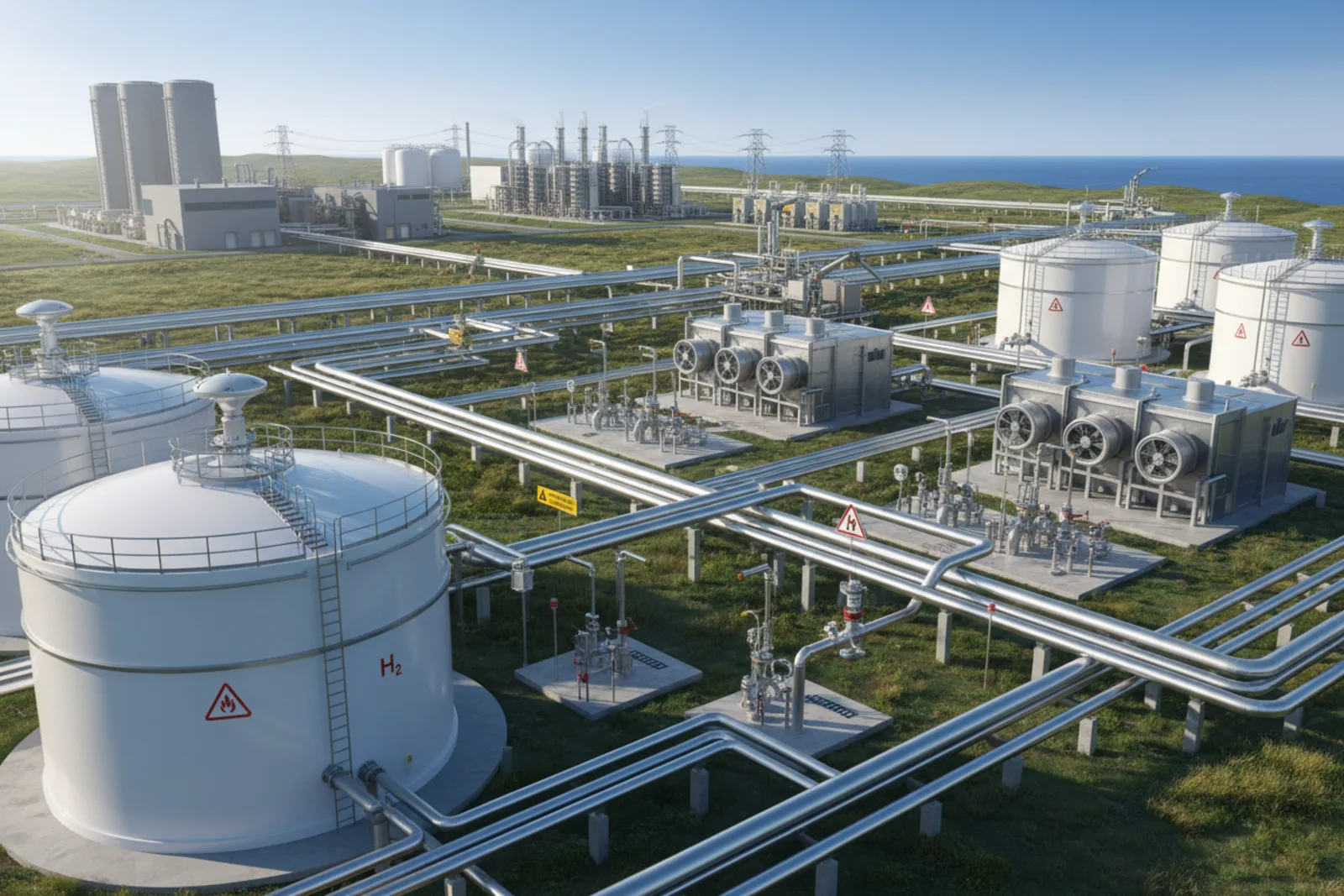
Artist’s impression: CFF hydrogen storage & distribution terminal
The real test is not whether CFF can supply hydrogen in a normal operating week. The test is whether Britain still has enough stored hydrogen when the country is hit by a prolonged low-wind spell, electrolysis output is cut back, and strategic demand from industry, freight, and grid support must still be met.
That means storage should be designed as a sovereign strategic reserve, not as a small balancing buffer. In engineering terms, the reserve has to cover a simultaneous power-system and hydrogen-system stress: reduced conversion output, elevated grid support requirements, and continued supply to protected end uses.
In plain terms: production can fall for weeks. The country still has to keep moving.
A credible minimum reserve is 8 to 12 weeks of protected hydrogen demand, measured against defined priority uses rather than gross headline production. Below that level, storage functions mainly as an operating buffer, not as a serious national resilience instrument.
A stronger national target is around 3 months of protected-demand hydrogen storage. That level provides materially greater cover against prolonged low-wind conditions, coincident outages, maintenance overlap, logistics disruption, or external supply shocks, and is a more defensible planning basis for a sovereign system.
Where geology and capital allow, a 4 to 6 month strategic reserve would represent the deepest security position. That is not a first-build requirement, but it is the logical long-run direction for a system designed around seasonal resilience rather than week-to-week optimisation.
| Storage Position | What It Means | Assessment |
|---|---|---|
| Days to 2 weeks | Short-duration operational balancing only | Too weak for a national low-wind resilience case |
| 8 to 12 weeks | Minimum credible reserve for protected strategic demand | Strong enough to support a real sovereign resilience argument |
| ~3 months | Preferred planning basis for prolonged system stress | Best fit for the document’s energy-security framing |
| 4 to 6 months | Deep seasonal strategic reserve | Exceptional long-duration security if buildable at scale |
Steel, fertiliser, chemicals, refining replacement, and other strategic industrial users should not be forced offline first during a low-wind event. Storage should first protect the hardest-to-replace domestic production chains and the users with the highest shutdown cost, restart difficulty, or strategic importance.
Hydrogen allocated to HGV corridors, logistics fleets, ports, and other high-importance transport functions should be backed by reserve stock so transport continuity is not broken by temporary production cuts or constrained conversion output.
If wind output is weak for an extended period, part of the reserve can be held for strategic power-system support through dispatchable hydrogen-to-power conversion where justified. That makes stored hydrogen a system-security asset, not just an industrial commodity.
Assume a prolonged low-wind spell in which CFF cuts hydrogen production by roughly 50% in order to redirect more firm nuclear power to the grid. Under that design basis, the hydrogen system cannot rely on live production to cover all protected demand and must instead draw against pre-built strategic inventory.
The reserve therefore has to bridge the gap between reduced production and essential demand over a sustained stress window. That is why the right unit of planning is not hours or a few days. It is weeks to months, with explicit assumptions on depletion rate, replenishment rate, and protected-demand hierarchy.
Write the programme around a minimum target of 8–12 weeks of protected-demand H₂ storage, with a central planning assumption of roughly 3 months where geology, cavern development, and transmission integration permit.
Under normal operation, 100% of each site’s 3.6 GWe is consumed on-site — powering HTSE electrolysis (hydrogen production) and desalination. No electricity goes to the national grid. The UK grid is normally run by wind and solar, supplemented by Hinkley Point C (3.2 GW) and Sizewell C (3.2 GW). CFF sites are hydrogen factories, not power stations.
The fleet’s total capacity (101.3 GWe across all 28 sites) is normally all committed to hydrogen production. Safe-Flex is a continuous, granular, site-by-site, real-time responsive system — not a two-state toggle.
This is a distributed, demand-responsive reserve margin — the kind of behaviour a National Grid ESO engineer actually cares about: local, dynamic, minute-by-minute response calibrated precisely to the shortfall.
Even at maximum 50% flex across all sites, the hydrogen numbers remain formidable:
| Metric | Full Load (100%) | Safe-Flex (50%) |
|---|---|---|
| Per site | 2,072 t/day | 1,036 t/day |
| National (28 sites) | 58,016 t/day | 29,008 t/day |
| Per hour | ~2,417 t/h | ~1,209 t/h |
| Per week | ~406,112 t/wk | ~203,056 t/wk |
| Per month | ~1.74M t/mo | ~870K t/mo |
| Per year (if sustained) | ~21.2M t/yr | ~10.6M t/yr |
| Energy equivalent | ~704 TWh/yr | ~352 TWh/yr |
Even at maximum 50% flex across all 28 sites, CFF still produces 29,008 t/day of green hydrogen — enough to keep industry and freight running. Meanwhile, up to ~50 GW of firm nuclear electricity flows to the grid. Operators can flex anywhere from 0% to 50% on any combination of sites — one site at 10%, five at 30%, all 28 at 50% — matching the response precisely to the shortfall. This is not a permanent power supply — it is a variable safety stream activated only when wind and solar cannot cope. The moment renewables recover, HTSE ramps back to full load and all electricity returns to hydrogen production.
For storage at this scale, the strongest practical route is not tanks at every site. It is a national system architecture built around salt caverns, other suitable underground storage formations, pipeline linepack, and regional strategic reserve hubs integrated with the coastal production fleet and trunk transmission corridors.
That matches the geography already implied elsewhere in the document: East Yorkshire, Cheshire, Teesside, and other suitable areas become part of a sovereign hydrogen reserve architecture rather than just production points. In engineering terms, the reserve should be spatially distributed enough to reduce single-point failure risk, but concentrated enough to preserve storage economics and operational control.
In Treasury terms, this is enabling infrastructure. Without storage, the production fleet is less flexible, less resilient, and less valuable in a stress event. With storage, the state converts variable operating surplus into a strategic reserve asset that can protect industrial output, transport continuity, and power-system security.
Produce at the coast. Store underground. Size the reserve to the stress case, not the average day.
The correct test is whether the storage system is large enough, connected enough, and controllable enough to preserve protected demand through a defined multi-week stress event. That requires explicit assumptions on usable working inventory, withdrawal rates, recharge windows, conversion capacity, and network constraints.
From a Treasury perspective, storage is not an optional add-on to production. It is part of the productive asset base that raises the resilience value, dispatch value, and strategic usefulness of the wider CFF platform. The state is not only buying output capacity; it is buying continuity under stress.
Build the hydrogen reserve as core national infrastructure, with clear design standards and a clearly stated protected-demand objective.
A hydrogen system without long-duration storage is not sovereign. It is a just-in-time system, fragile by design. If the wind falls away for weeks, Britain still needs power, industry still needs molecules, and freight still needs fuel.
So the reserve must be measured in weeks and months — not days. Minimum 8 to 12 weeks. Planning basis around 3 months. Strongest when Britain can hold a season.
Every mega-site generates co-products directed to the public first. Heat Halo homes pay a flat £500/year for unlimited heating and hot water — less than the Netherlands. Other co-products are supplied to public services at priority, with surplus sold into domestic industry.
Unlimited heating and hot water for a flat £500/year per home — less than the Netherlands pays for district heat. Up to ~280,000 homes per site within 10 miles, using waste heat from HTGR modules. This turns NIMBY into YIMBY: low-cost heat forever becomes part of the fabric of the property, increasing house prices in Halo areas. Already proven at scale — Copenhagen's system serves ~1 million people with over 98% reliability.
HTSE electrolysis produces oxygen as a high-value co-product. Public services are supplied first, with the NHS taking priority for medical oxygen and emergency resilience. But NHS demand would absorb only a fraction of total output, so surplus oxygen is sold onward to domestic industry for steelmaking, glass manufacture, cement and lime processes, wastewater treatment, chemicals, and other oxygen-intensive uses. In a CFF configuration, HTSE is preferable because 700°C steam from HTGR modules goes directly to the electrolysers, making hydrogen and oxygen generation more thermodynamically efficient than lower-temperature alternatives.
Zero-waste brine processing supplies road de-icer to councils first, but road maintenance would use only part of the total stream. The remainder can be sold onward into domestic industry as brine, salt, and recovered mineral feedstocks for chemicals, treatment processes, materials production, and wider manufacturing use. Magnesium and other mineral recovery routes may strengthen over time. Any DLE-linked lithium pathway is a future option only, becoming a revenue stream only if the technology matures to dependable commercial scale.
Each site has four desalination units — one dedicated to hydrogen production and two flexible units sized to site-specific industrial and food-production demand. Salt water cannot enter the reactors or electrolysers. The fourth unit is a strategic reserve that does not feed the internal system and is never committed to routine duty — it is activated only during droughts or when farmers need irrigation support. Each reserve unit produces 50,000 m³/day. 1.4 million m³/day nationally on standby to de-couple UK food production from rainfall.
The Heat Halo is a 200-year infrastructure asset at a fixed £500/year. Rolling maintenance and modular upgrades mean affordable warmth is a permanent local inheritance — baked into the property value, not a temporary project. When a Heat Halo home is sold, the connection transfers with the property.
If developed across 28 national energy sites, a 10-mile Heat Halo model could potentially provide heating and hot water for up to 7.84 million homes at a flat £500/year — unlimited heating and hot water, for less than the Netherlands pays for district heat. That fixed cost creates a sovereign British heat network backed by 200-year nuclear infrastructure, not volatile gas markets.
The £500/year connection also creates an additional revenue stream for the programme — 7.84 million homes × £500 = £3.92 billion/year in stable, predictable income that supports the progressive self-funding model.
The planning argument is transformative. Low-cost heat and hot water forever turns NIMBY into YIMBY. Communities actively welcome a CFF site because it raises property values — the Heat Halo connection becomes part of the fabric of the property, transferred on sale. A home with guaranteed £500/year heating for 200 years is worth more than one dependent on gas boilers. Estate agents will market it. Mortgage lenders will recognise it. Local authorities will support it. The planning battle becomes a planning invitation.
CFF should be explicit about co-product priority. Public services come first. Heat Halo homes get unlimited heating for £500/year. The NHS takes first call on medical oxygen. Councils and the road network take first call on de-icer and winter-resilience brine. Domestic resilience use is the first duty of the system.
But those public-service uses would consume only a fraction of total output. The remainder is not waste. Surplus oxygen can be sold onward into steelmaking, glass manufacture, cement and lime production, wastewater treatment, chemical processing, bleaching, oxidation chemistry, and other oxygen-intensive industrial uses. Surplus brine and recovered salts can be sold onward as chemical feedstocks and process inputs for chlor-alkali chains, water-treatment chemicals, industrial salt demand, minerals processing, and wider manufacturing applications.
That framing matters because it keeps the hierarchy clear: first protect public services, then monetise the remainder through British industry instead of dumping or undervaluing it.
Nothing wasted. Public need first. Industrial surplus sold into the home economy.
One national infrastructure, six essential tools. Public services and national resilience come first; where output exceeds public need, the surplus can then be directed into the wider home economy instead of being wasted.
Scenario: No wind/sun + Cold Spike
Action: Safe-Flex ramps HTSE down — anywhere from 1% to 50% per site, across as many of the 28 sites as needed
Result: Up to 1.8 GW freed per site, scaling to ~50 GW nationally when all 28 flex to maximum. Even at 50% load, CFF still produces 29,008 t/day of hydrogen. Operators match the flex precisely to the shortfall — one site at 10%, five at 30%, all 28 at 50%.
Scenario: National Drought / Crop Failure
Action: Activate the Strategic Water Reserve
Result: 1.4 million m³/day of fresh water to help de-couple UK food production from rainfall.
Scenario: Global Oil/Gas Price Shock
Action: Maintain 100% British-made hydrogen production
Result: 58,016 tonnes/day of H₂ at a stable domestic supply model. UK economy fully decoupled from foreign energy markets.
Scenario: Pandemic / Mass Casualty
Action: Divert oxygen co-product from HTSE to NHS first
Result: Hospitals get priority access in crisis conditions, with surplus oxygen then available for steel, glass, cement, wastewater treatment, chemicals, and other domestic industrial users.
Scenario: Prolonged Sub-Zero / Ice Emergency
Action: Release zero-waste brine stockpile to councils first
Result: Road resilience is protected first, while surplus brine and recovered salts can then move into chemical feedstocks, treatment processes, industrial salt demand, and wider domestic manufacturing.
Scenario: Supply Chain Disruption / Sanctions
Action: Use brine and mineral streams first for present-day domestic industrial feedstocks
Result: Chemical and materials inputs are retained in Britain, while any DLE-linked lithium pathway remains a future option only if the technology matures to dependable commercial scale.
CFF targets ~£15 billion per complete site at series-production scale — the cost once UK manufacturing is established and the fleet effect has matured (~site 7 onward). Here is the full breakdown — line by line, sourced from real-world project data, peer-reviewed estimates, and government-grade cost studies. Reactor costs are based on China’s HTR-PM and X-energy Xe-100 repeat-build targets. The staged build strategy means the initial ask is far smaller.
| Component | Estimated Cost | Basis & Sources |
|---|---|---|
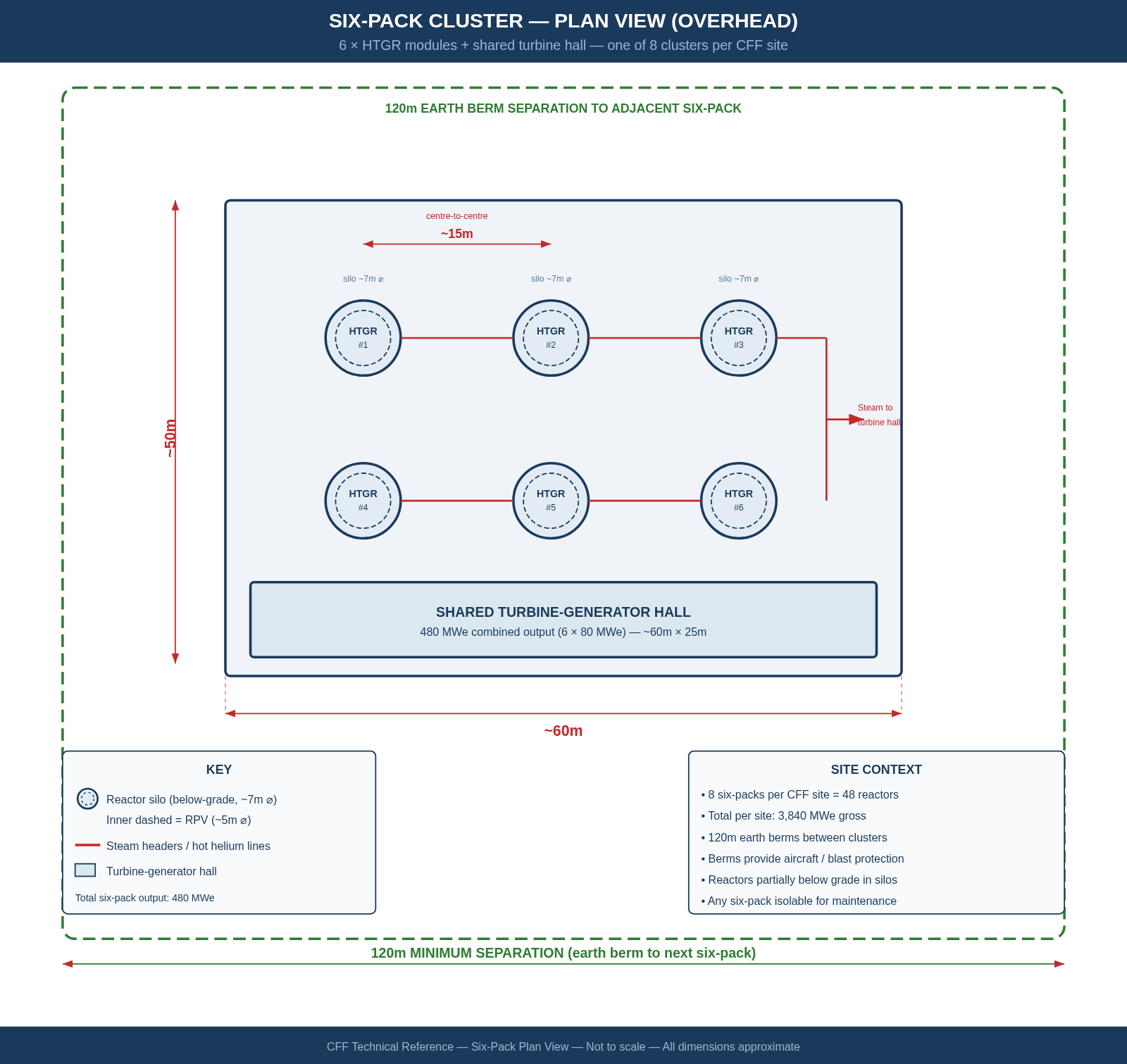
| 48 × HTGR Reactor Modules 3,840 MWe total capacity | £6.5 – £7.5B | China’s HTR-PM600 targets ~$2,000–$2,500/kWe at NOAK fleet scale. Idaho National Laboratory (INL) estimates $2,075–$2,600/kWt for a 600 MWt four-pack. At midpoint ~$2,200/kWe × 3,840 MWe ≈ $8.4B → ~£6.8B. |
| 44 × HTSE Electrolyser Banks High-temperature solid-oxide units | £1.5 – £2.0B | INL (2020) projects NOAK total installed cost of ~$703/kW-dc for HTSE at scale. Stack costs fall to ~$78/kW-dc at 1 GW/yr manufacturing volume. For ~2.5 GW equivalent electrolysis capacity → ~£1.7B central. |
| Civil Works & Earth Berms Foundations, structures, earthworks, security | £1.5 – £2.0B | Nuclear civil works typically 25–35% of reactor island cost (IAEA TecDoc-1556). Earth berms (15–20 m high, 3–5 km perimeter) add ~£30–60M based on large earthworks at £8–15/m³. Security, access roads, seismic isolation pads included. |
| District Heating Network ~280,000 homes within 10-mile Heat Halo | £1.0 – £1.5B | UK district heating costs £600–£1,900/metre depending on pipe diameter (BEIS / HNDU 2013/14 data, inflated ~30% for 2024). Copenhagen’s network serves ~1M people at comparable per-connection cost. 50–80 km of trunk mains plus local distribution. |
| Hydrogen Pipeline Infrastructure Transmission + distribution corridors | £0.5 – £0.8B | IEA estimates $2–3M/km for onshore H₂ transmission pipelines, $0.3–0.7M/km for distribution. Germany’s H₂ backbone averages €2.04M/km. Assuming 200–300 km of mixed network per site → ~£0.6B central. |
| Grid Connection & Substations Safe-Flex HVDC link + switchgear + grid interface | £0.3 – £0.5B | Required for Safe-Flex emergency grid supply — each site can divert up to 50% of its 3.6 GWe (= 1.8 GW) to the grid when wind and solar fail. Hinkley Point C grid connection cost ~£800M for 3.2 GW (NG ESO data). CFF sites connect up to 1.8 GWe via Safe-Flex. Scaled estimate → ~£0.4B. |
| TRISO Fuel — Initial Core Load HALEU uranium fuel pebbles for 48 modules | £0.2 – £0.4B | HALEU TRISO fuel ~$30,000/kgU for fabricated fuel form (INL / DOE estimates). Each 250 MWt module needs ~2–3 tonnes initial load. 48 modules × ~2.5t × $30K/kg ≈ $3.6B over full programme, ~£0.3B per site. |
| Desalination Plant (4 Units) 1 hydrogen feedwater + 2 flexible; 1 strategic reserve (50,000 m³/day) | £0.2 – £0.35B | Large-scale seawater RO: $800–$1,100 per m³/day capacity (DesalData / GWI). 4 units (1 hydrogen feedwater + 2 flexible + 1 strategic reserve) at varying capacities. The reserve unit alone ≈ $40–55M. Total desalination infrastructure → ~£0.25B per site. |
| Seawater Intake & Marine Works Cooling, intake tunnels, outfall | £0.2 – £0.4B | Comparable to Hinkley Point C and Sizewell C marine works. Deep-water intake tunnels, fish-return systems, and brine diffuser outfalls. Standardised design across fleet reduces per-site cost. |
| Contingency & Project Management ~10% of total — standard for mega-projects | £1.0 – £1.5B | HM Treasury Green Book recommends 10–15% contingency for large infrastructure. As a FOAK build, Site 1 sits at the higher end of the range. Later fleet builds would benefit from reduced contingency as risks are retired. |
| TOTAL PER SITE | £13.0 – £16.2B | Central estimate: ~£15 billion |
The ~£15 billion figure is the target cost for a complete six-output site at UK series-production scale — roughly site 7 onward, once UK reactor factories are operational and the fleet effect has driven costs down. The first few sites use imported HTGR modules from established manufacturers while UK factories are built in parallel. And critically, no site is built all at once — each follows a defined staged sequence, starting with Stage 1 (reactors + electricity) which earns revenue before any downstream module is added. The initial ask is a fraction of the full-build figure.
No honest cost estimate for a programme of this scale can give a single exact number. The ranges above reflect the genuine uncertainty in cost projections, exchange rates ($→£ at ~0.78–0.80), and construction market conditions. The central estimate of ~£15B sits comfortably within the range at series-production pricing and is deliberately not the most optimistic figure.
All cost data above is drawn from publicly available sources: Idaho National Laboratory cost studies, China’s HTR-PM programme data, IEA hydrogen pipeline reports, BEIS/DESNZ district heating analysis, HM Treasury Green Book guidance, DesalData/GWI desalination benchmarks, and National Grid ESO connection cost data. Nothing is invented. Every number can be checked.
Britain spent ~£400 billion responding to COVID in two years and got no permanent infrastructure in return. CFF proposes spending roughly the same amount over twenty years and getting 200 years of sovereign energy, 500,000+ permanent jobs, and complete independence from foreign fossil fuels. The question is not whether Britain can afford it. The question is whether Britain can afford not to.
Electrification is essential for much of the economy, but it cannot solve every challenge alone. Heavy freight, steel, chemicals, fertiliser, and seasonal grid backup all require stored energy in molecular form. CFF uses electricity where it fits best and reserves hydrogen for the hardest jobs the grid does not solve well on its own.
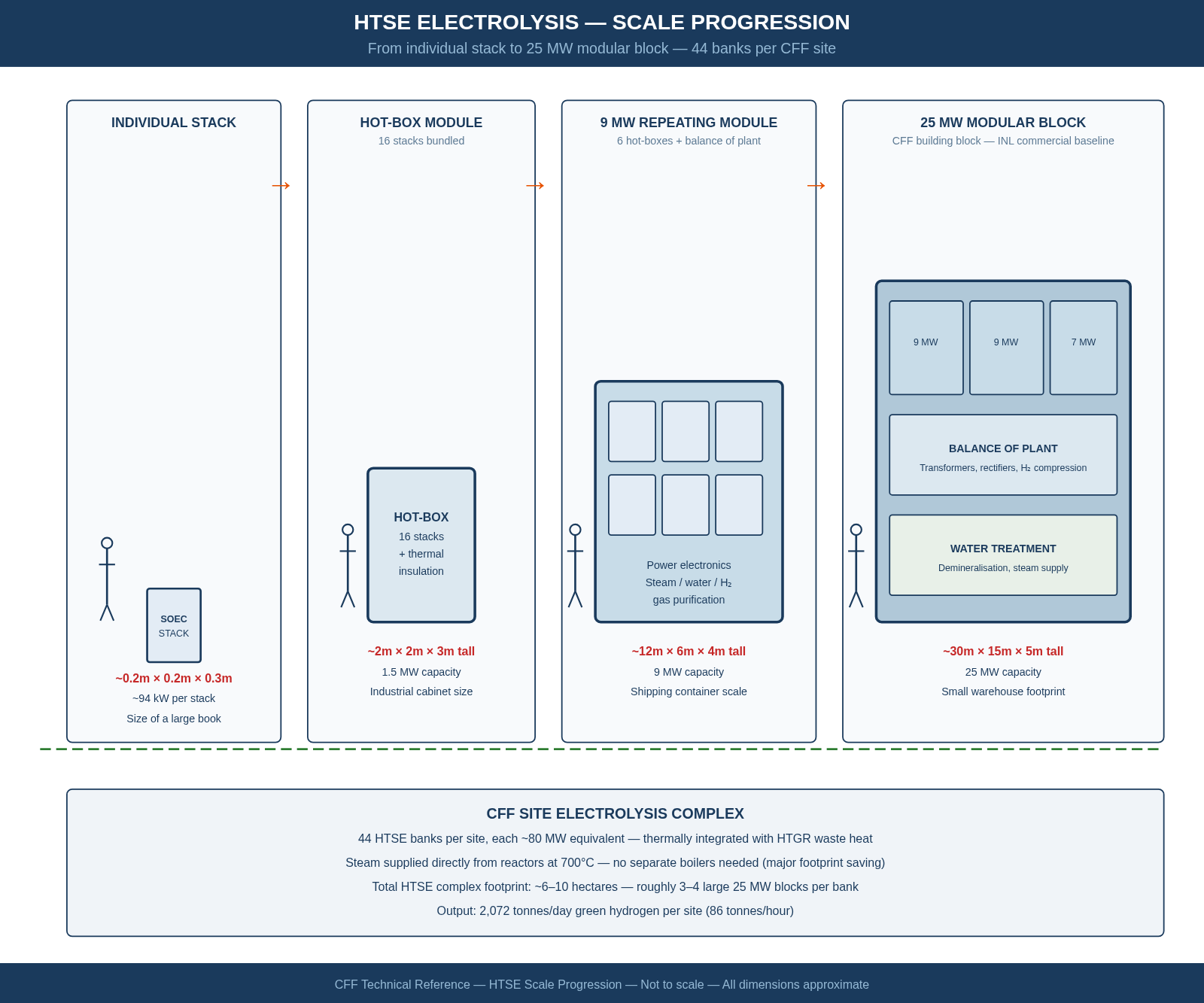
At full HTSE load across all 28 sites, CFF would produce 58,016 tonnes of green hydrogen per day — equivalent to 21.2 Mt/year (~704 TWh/year). Each site has 44 HTSE banks splitting 700°C steam at ~40 kWh/kg H₂.
High-Temperature Steam Electrolysis (HTSE) splits 700°C steam into hydrogen and oxygen. HTGR modules produce helium at 750°C which generates 700°C steam — directly compatible with the electrolysers. No parasitic electrical heating is needed, unlike PWR designs where 285°C steam would require 60–70% of output just to reach operating temperature.
Under normal operation, all 3.6 GWe per site powers hydrogen production and desalination — none goes to the grid. The UK grid is run by wind, solar, plus Hinkley Point C (3.2 GW) and Sizewell C (3.2 GW). During dunkelflaute, Safe-Flex activates: any site can ramp HTSE down by 1% to 50%, freeing up to 1.8 GW per site for the grid. This can apply to any combination — from one site alone up to all 28 — giving Britain up to ~50 GW of firm backup on demand. Even at maximum flex, CFF still produces 29,008 tonnes/day of hydrogen. The moment renewables recover, HTSE ramps back up and all electricity returns to hydrogen production.
By DJ Waugh — Retired Engineer & Creator of Carbon Free Future