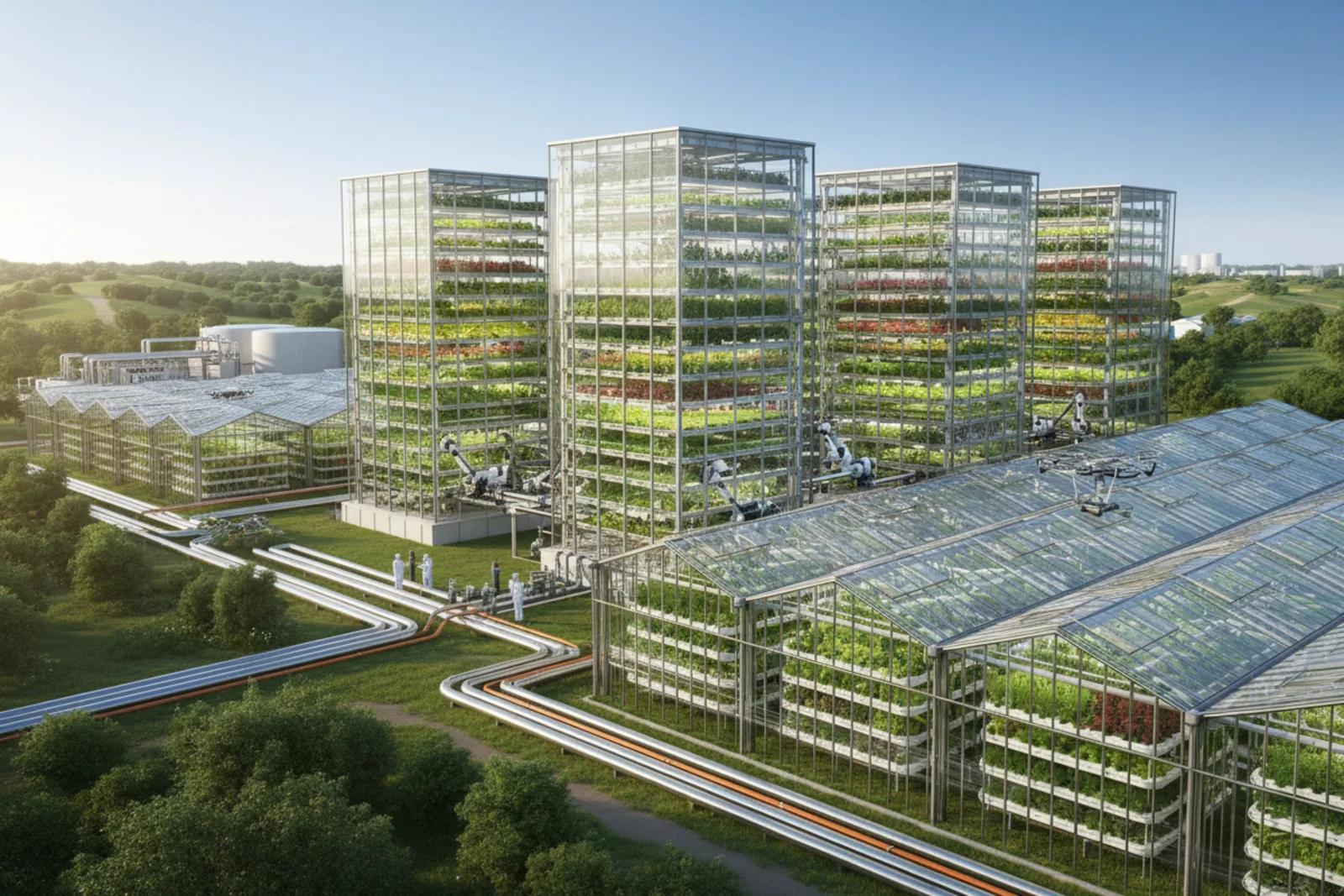
Vertical farming & hydroponics complex — year-round crop production using waste heat and desalinated water
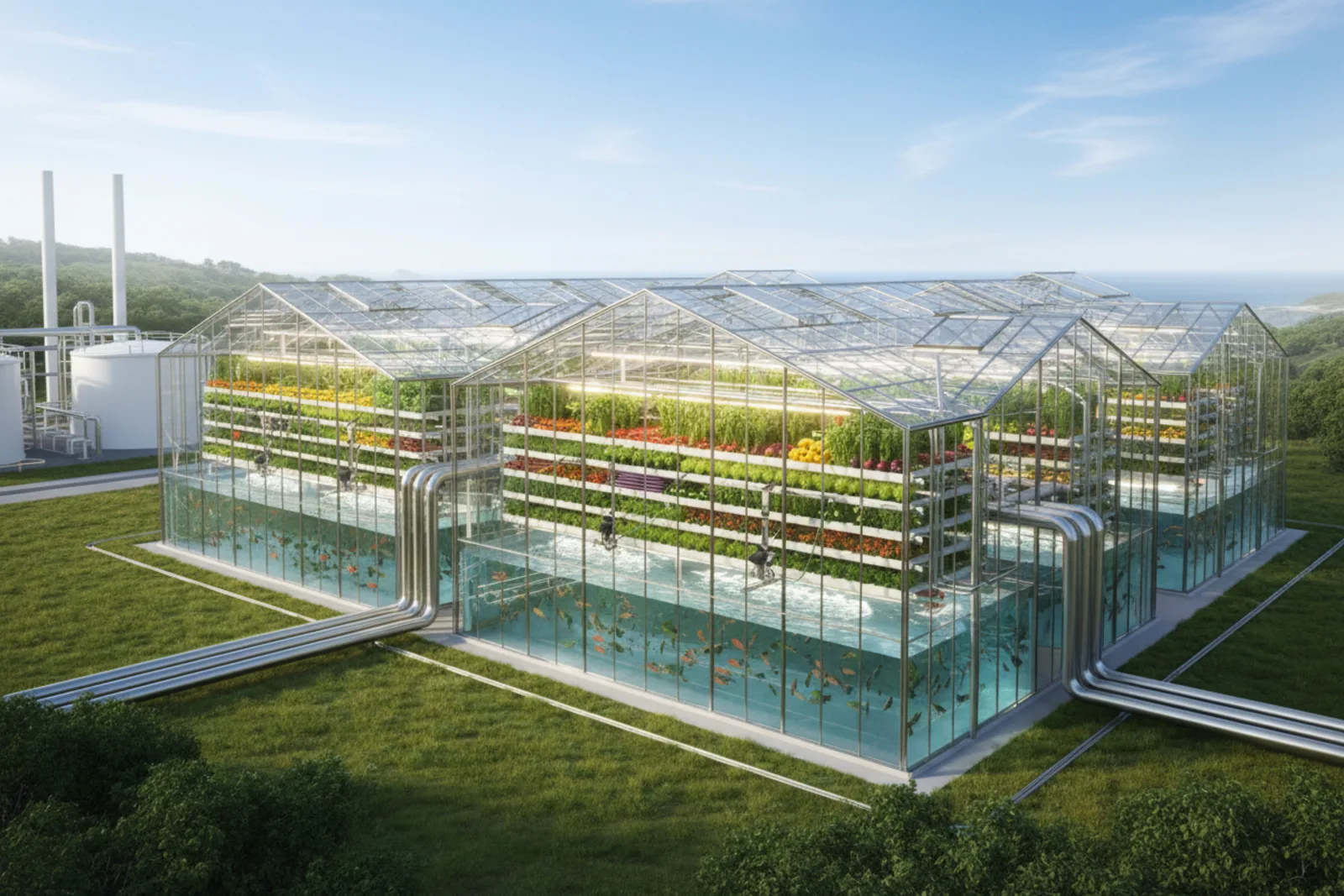
Aquaponics facility — fish farming and crop production in a closed-loop system
CFF's primary mission is energy independence — hydrogen, firm power, and an end to Britain's reliance on imported fossil fuels. But that infrastructure produces three things in limitless abundance: clean heat, desalinated water, and cheap electricity. Once you have all three, you can grow any crop on Earth, raise any fish in the sea, and let collapsing wild stocks finally recover. This page is about what comes next.
CFF begins with 28 coastal mega-sites around Britain's shoreline. Their primary job: produce green hydrogen at industrial scale using 48 HTGR reactor modules per site. Each site also desalinates seawater, delivers district heating, and generates firm baseload power. This is the core energy programme.
As wind farms and solar panels reach end-of-life (25–30 years), Britain can replace them permanently with inland CFF sites built on former coal and gas power station land. These sites focus on firm grid electricity and district heating. Fresh water is piped from the nearest coastal site via a dedicated Inland Supply Unit desalination module. See the Renewal case.
Every CFF site — coastal or inland — produces waste heat, cheap electricity, and desalinated water far beyond its core energy needs. That surplus powers food production campuses on the perimeter of each site: climate-controlled greenhouses, vertical farms, and indoor fish farms that can grow any crop and raise any species, year-round. This is what this page is about.
The 8-step production cycle on the homepage covers what every coastal site does — four desalination units strip the salt from seawater, one dedicated to hydrogen production and two flexible, while the fourth is held as an independent Strategic Reserve for emergency water.
Inland Supply Unit is different. It's an additional desalination module added to selected coastal sites closest to inland CFF locations. Its sole job is to produce ultra-pure fresh water and pipe it inland — supplying the inland site's industrial ecosystem, food production campus, and district heating make-up water. Zero draw on any river, aquifer, or water table.
You'll see Inland Supply Unit referenced throughout this page and the Renewal page. Every time it appears, it means: desalinated seawater, piped from the coast, at negligible energy cost.
The food production described below isn't a separate programme. It's a by-product of the energy infrastructure — built on surplus outputs that would otherwise go to waste. Every site that produces hydrogen also produces the heat, water, and power to grow food. The only question is whether Britain chooses to use it.
Vertical farming & hydroponics complex — year-round crop production using waste heat and desalinated water
Aquaponics facility — fish farming and crop production in a closed-loop system
A CFF site doesn't host a single greenhouse or a single fish tank. The perimeter of every site — coastal or inland — can support multiple independent production facilities, each purpose-built for a different crop or species, each drawing from the same shared supply of waste heat, cheap electricity, and desalinated water.
Tropical fruit — avocados, citrus, mangoes. Climate-controlled to replicate equatorial growing conditions year-round.
Cold-water RAS tanks — Atlantic salmon, cod, haddock, trout. Precise temperature for optimal cold-water growth.
Warm-water aquaculture — tropical prawns, tilapia, sea bass. Waste heat maintains perfect tropical conditions.
High-value controlled environment — saffron, vanilla, speciality herbs. Lighting calibrated to replicate any latitude.
Glasshouse crops — tomatoes, peppers, cucumbers, strawberries. Heated year-round at zero energy cost.
Vertical farm — leafy greens, herbs, microgreens. Fast-cycle production for local supermarkets and public procurement.
🔄 Seasonal flexibility is built in. When demand for British strawberries peaks in summer, capacity shifts. When winter drives up prawn consumption, warm-water tanks scale up. When a wild fish stock needs emergency protection, CFF facilities can absorb the demand overnight — taking pressure off the ocean within weeks, not decades. This isn't a farm. It's a food production campus that can pivot faster than any supply chain on Earth.
Desalinated water from Inland Supply Unit arrives as ultra-pure H₂O — a blank canvas. That's not a problem. It's the entire point. Pure water can be remineralised to any specification, creating the exact water chemistry required for each use. And here's the elegant part: the minerals come from the desalination process itself. The brine concentrate left behind by Inland Supply Unit is rich in calcium, magnesium, potassium, sodium, and trace elements. Instead of discharging it, CFF mines it for precisely the minerals each facility needs.
| End Use | Minerals Added | Why | Source |
|---|---|---|---|
| 🚰 Drinking Water | Calcium (40–80 mg/L), magnesium (10–30 mg/L), fluoride | Bone health, cardiovascular health, dental protection, taste, pipe corrosion prevention | Brine-recovered calcium carbonate + magnesium hydroxide |
| 🐟 Salmon / Trout (10–14°C) | Calcium, magnesium, alkalinity buffer (>70 mg/L), dissolved oxygen boost | Osmoregulation, bone development, stable pH for biofilter bacteria | Brine-recovered minerals + HTSE by-product oxygen |
| 🦐 Prawns / Shrimp (28–32°C) | Na, K, Mg, Ca in seawater ratios (Na:K 28:1, Mg:Ca 3.4:1), alkalinity >75 mg/L | Moulting, osmotic balance — prawns need near-seawater ionic profiles | Diluted brine concentrate (already contains the exact ratios) |
| 🐟 Tilapia / Sea Bass (24–30°C) | Calcium, magnesium, moderate hardness (>50 mg/L) | Growth, disease resistance, stable water chemistry | Brine-recovered lime + magnesium salts |
| 🍅 Tomatoes / Peppers | N, P, K, Ca, Mg, Fe + 8 micronutrients (Mn, Zn, Cu, B, Mo, Cl, Ni, S) | Complete nutrient solution for fruiting crops — pH held at 5.5–6.5 | Brine-recovered K, Ca, Mg + standard nutrient concentrates |
| 🥑 Avocados / Citrus | Higher calcium demand, balanced N-P-K, micronutrients | Heavy fruit crops strip calcium — constant top-up needed | Brine-recovered calcium + balanced nutrient feed |
| 🌸 Saffron / Vanilla | Light nutrient load, precise pH (5.5–7.0), low EC (~1.4) | Delicate high-value crops need gentle chemistry | Ultra-pure desalinated base + minimal brine-recovered minerals |
| 🥬 Leafy Greens / Herbs | Nitrogen-heavy solution, moderate K, low Ca | Fast-cycle crops prioritise leaf growth over fruiting | Standard hydroponic nutrient mix in pure water base |
Desalination doesn't just produce water. It produces two outputs — pure water and mineral-rich brine. CFF uses both. The pure water becomes the base. The brine becomes the mineral pharmacy. Nothing is wasted. Every drop is engineered to purpose.
Britain spends over £6 billion a year importing fresh fruit and vegetables — most of it from water-stressed regions facing climate collapse. A CFF inland ecosystem doesn't just grow food. It eliminates the reason we import it.
The UK imports ~134,000 tonnes of avocados a year. Every kilogram requires 600–1,000 litres of water — extracted from drought-stricken regions in Peru, Chile, and South Africa. One hectare of avocado trees in Chile can consume 100,000 litres per day — enough for 1,000 people.
A climate-controlled CFF growing facility maintains the exact 20–25°C temperatures avocados need, year-round, using free waste heat. Desalinated water from Inland Supply Unit feeds a closed-loop hydroponic system that uses up to 90% less water than open-field farming — and draws nothing from any river, aquifer, or water table, anywhere. The base feedstock is seawater. The energy cost is zero. The food miles are zero.
Britain imports ~£800M of tomatoes a year — mostly from the Netherlands, Spain, and Morocco. Dutch greenhouses burn natural gas for heating. Spanish growers drain the already parched Almería aquifer. Moroccan farms compete for water in a country facing severe drought. All of it then travels hundreds of miles by refrigerated lorry.
Waste heat replaces gas. Desalinated water replaces aquifer extraction. The growing environment is identical — heated glasshouse at 18–24°C — but the energy bill is zero, the water supply is unlimited, and the tomatoes are grown 20 miles from the supermarket, not 2,000.
Saffron — the world's most expensive spice — requires labour-intensive harvesting and specific climate conditions found only in Iran, Kashmir, and parts of Spain. Traditional soil cultivation uses over 8,000 litres of water per kilogram. Vanilla comes almost exclusively from Madagascar, where cyclones regularly destroy harvests. These are crops Britain has never been able to grow.
In a CFF controlled environment, temperature, humidity, and light are precisely managed to replicate any growing climate on Earth. Hydroponic saffron uses 80–90% less water. Multiple harvests per year become possible instead of one. With free heat, free water, and free electricity, the economics of growing the world's most expensive crops in Britain aren't just viable — they're transformative.
A conventional greenhouse fights the British climate. A CFF inland ecosystem ignores it. With waste heat controlling temperature, Inland Supply Unit desalinated water on tap, and the cheapest firm electricity in the country, these facilities can replicate the growing conditions of Spain, Kenya, or Thailand — 365 days a year. Every crop currently stamped 'Produce of Spain' or 'Grown in Morocco' becomes a candidate for British production.
Britain imports over £4 billion of seafood a year — and half of the UK's top ten commercial fish stocks are either critically low, overexploited, or both. ICES has recommended a zero-catch limit for North Sea cod in 2026. The answer isn't to stop eating fish. It's to stop taking it from the ocean.
A CFF ecosystem with Recirculating Aquaculture Systems (RAS) can raise almost any species of fish indoors — in precisely controlled, disease-free, closed-loop tanks heated by free waste heat, fed by Inland Supply Unit desalinated water, and oxygenated by HTSE by-product oxygen. Every fish raised inside a CFF facility is a fish that never needs to be taken from the wild.
The UK imports 91% of its cod — over 190,000 tonnes a year (~£486M). North Sea cod is in such critical decline that scientists recommend catching none at all in 2026. Haddock (~£196M imported) faces similar pressure. Yet cod and haddock remain the nation's favourite fish — the backbone of every chippy in Britain.
Indoor RAS tanks, maintained at the exact cold-water temperatures cod and haddock require (6–12°C), fed with clean desalinated water from Inland Supply Unit, and oxygenated with HTSE by-product oxygen. No sea lice. No bycatch. No discards. No impact on wild stocks whatsoever. British cod, raised in Britain, served in British chip shops — while wild North Sea stocks are finally given the breathing space to recover.
The UK imports ~£580M of prawns and shrimp a year — much of it from tropical farms in Southeast Asia and Latin America. Industrial shrimp farming has destroyed an estimated 38% of the world's mangrove forests — some of the most carbon-rich ecosystems on Earth. These farms drain aquifers, pollute coastal waters with antibiotics, and are linked to forced labour and land seizures.
Warm-water prawn species thrive in RAS tanks at 28–32°C — a temperature trivially maintained with free CFF waste heat. Desalinated water from Inland Supply Unit, remineralised with brine-recovered minerals to match seawater ionic profiles. Zero antibiotics in a closed biosecure system. Zero mangrove destruction. Zero food miles. The UK can eat prawns without destroying tropical coastlines on the other side of the world.
The UK's most valuable seafood import — ~£743M a year, over 121,000 tonnes. Most comes from Norwegian sea-cage farms plagued by sea lice, disease outbreaks, and antibiotic use. Wild Atlantic salmon populations are in long-term decline across UK rivers.
Indoor RAS salmon farming is already proven technology — land-based salmon farms are operating in Norway, Denmark, and the US right now. CFF makes it radically cheaper: free waste heat to maintain water temperature, free desalinated water, free oxygen from HTSE. No sea lice. No escapes into wild populations. No antibiotic contamination of coastal waters. British-raised salmon at a fraction of the environmental cost.
| Product | UK Import Bill | Environmental Damage | CFF Solution |
|---|---|---|---|
| 🥑 Avocados | ~£300M/yr | 600–1,000 litres water/kg from drought regions | Closed-loop hydroponics, Inland Supply Unit water, free heat |
| 🍅 Tomatoes | ~£800M/yr | Dutch gas heating, Spanish aquifer depletion | Free waste heat, desalinated water |
| 🌸 Saffron | World's priciest spice | 8,000+ litres/kg, single annual harvest | 80–90% less water, multiple harvests/yr |
| 🐟 Cod & Haddock | ~£682M/yr | North Sea stocks at zero-catch crisis | Indoor RAS, cold-water tanks, HTSE oxygen |
| 🦐 Prawns | ~£580M/yr | 38% of global mangroves destroyed | Warm-water RAS, zero antibiotics, zero deforestation |
| 🐟 Salmon | ~£743M/yr | Sea lice, disease, antibiotic pollution | Land-based RAS, free heat/water/oxygen |
Any large-scale food production system will face scrutiny from animal welfare advocates. CFF doesn't shy away from that conversation — it welcomes it. Because the honest comparison isn't between CFF aquaculture and some imagined cruelty-free world. It's between CFF aquaculture and what's happening right now.
dolphins, whales & porpoises killed as bycatch every year
seabirds — including 14 species of albatross — drowned in nets
sea turtles killed annually — tangled, crushed, drowned
sharks and rays — many species now facing extinction
CO₂ released annually from bottom trawling — equal to global aviation
ghost fishing nets enter the ocean every year, killing for decades
| Industrial Wild Catch | CFF Indoor Aquaculture | |
|---|---|---|
| Bycatch | Millions of non-target animals killed per year | Zero — only the target species is in the tank |
| Dolphin/whale deaths | 300,000+ per year globally | Zero — no nets in the ocean |
| Seabed destruction | Trawling bulldozes ancient coral and seagrass | Zero — no contact with any seabed |
| Ghost nets | Up to 1 million tonnes/yr, killing for decades | Zero — no nets in the ocean at all |
| CO₂ from seabed | ~370 million tonnes/yr | Zero |
| Disease | Antibiotics discharged into open water | Closed biosecure system — zero antibiotics |
| Water quality | Polluted, parasite-ridden seas | Clean desalinated water, monitored 24/7 |
| Temperature | Whatever the ocean gives them | Precisely controlled to optimal range |
| Slaughter | Suffocation on deck, crushed in nets | Humane percussive/electrical stunning |
The biggest animal welfare argument for CFF isn't about what happens inside the facility. It's about what happens when we stop taking fish from the sea.
Every species of fish raised in a CFF facility is a species that no longer needs to be hunted from the wild. When CFF absorbs the demand for cod, haddock, salmon, and prawns, the pressure on wild stocks doesn't just reduce — it can stop entirely for the species that need it most.
The evidence is clear: when you stop fishing, stocks recover. The US Magnuson-Stevens Act proved that science-based catch limits allowed 52 depleted fish stocks to rebuild. North Sea plaice recovered when limits matched scientific advice. The principle is universal — give the ocean breathing space, and it heals.
CFF doesn't just give it breathing space. It gives the ocean a generation of peace. No nets. No trawls. No longlines. No ghost gear. No bycatch. The dolphins swim free. The turtles nest undisturbed. The coral regrows. The seabed recovers. The entire marine ecosystem begins to heal — not because we stopped eating fish, but because we stopped taking it from the ocean.
CFF doesn't claim fish farming is perfect. Fish are living creatures, and any farming system must be held to the highest welfare standards — controlled stocking density, clean water, environmental enrichment, humane slaughter, and independent oversight.
But the question isn't 'Is CFF aquaculture perfect?' The question is: 'Is it better than what we're doing now?' Right now, we are strip-mining the ocean, collapsing wild stocks, drowning dolphins, destroying coral reefs, and pumping 370 million tonnes of CO₂ from the seabed — all to put cod on a plate. CFF offers a different deal: eat the same fish, raised in clean water, under controlled welfare standards, with zero impact on wild populations — and let the ocean recover. That isn't an argument against animal welfare. It's the strongest animal welfare argument in British food policy.
This is the question the ocean recovery argument will always provoke — and it deserves an honest answer. CFF does not pretend that a transition away from industrial wild-catch fishing has no human cost. It does. Fishing communities are real, their heritage is deep, and their skills are hard-won.
But here's the thing: CFF doesn't make fishermen redundant. It gives them somewhere better to go.
Every CFF site has Buildings B and C — large-scale Recirculating Aquaculture Systems (RAS) raising cod, haddock, salmon, trout, prawns, tilapia, and sea bass. These facilities need people who understand:
That's not a retraining programme dreamed up in Whitehall. That's the skillset fishing families already have — passed down through generations. The transition is from dangerous, weather-dependent, declining work at sea to stable, year-round, better-paid indoor aquaculture at a facility within commuting distance of the same coastal community.
And this isn't theoretical. The fishing industry is already in crisis — declining stocks, tighter quotas, rising fuel costs, an ageing fleet, and a generation of young people who don't want to inherit a dying trade. CFF doesn't accelerate that decline. It offers an exit that preserves the identity of the community — still working with fish, still producing British seafood, still feeding the nation. Just not destroying the ocean to do it.
Across 28 coastal and near-coastal sites, CFF aquaculture creates thousands of permanent, skilled jobs — more than the current UK fishing fleet employs. The boats may eventually stop going out. But the fishing towns don't die. They become the centres of a new British aquaculture industry, built on the same knowledge, the same pride, and the same connection to the sea — without taking a single fish from it.
CFF doesn't abandon fishing communities. It gives them the future that the ocean can no longer provide.
Each CFF facility receives the same ultra-pure desalinated water from Inland Supply Unit and remineralises it to the exact recipe required — drinking water for the local town, cold-water tanks for British cod, warm brackish pools for tropical prawns, precision nutrient solutions for avocados and saffron. The brine by-product supplies the minerals. The waste heat controls the climate. The electricity powers the lighting and pumps. Every input is free. Every output displaces an import. This is what a sovereign food system looks like.
By DJ Waugh — Retired Engineer & Creator of Carbon Free Future