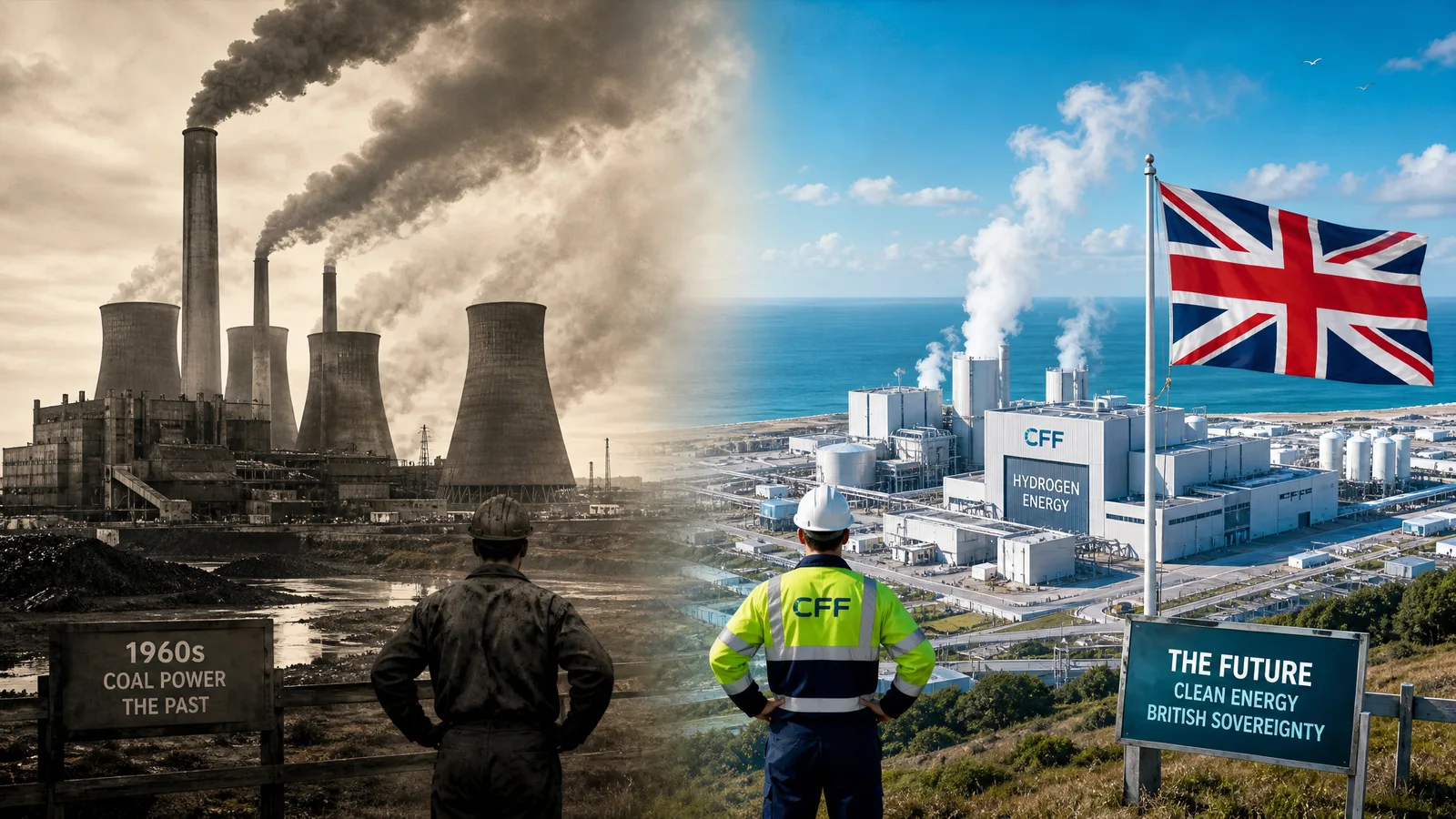
From coal to clean: Britain’s energy story — the same ambition, the same workforce spirit, a sovereign future
From the state-led reconstruction after World War II to the oil-rich decades of the North Sea boom, the United Kingdom once stood as a model of energy self-sufficiency. This is the story of how that sovereignty was lost — and why it must be regained.
From coal to clean: Britain’s energy story — the same ambition, the same workforce spirit, a sovereign future
From the state-led reconstruction after World War II to the oil-rich decades of the North Sea boom, the United Kingdom once stood as a model of energy self-sufficiency. This analysis traces the UK's journey from energy independence to significant import dependency — examining the pivotal role of nationalisation in rebuilding the nation, the golden era of North Sea production, and the ideological shift towards privatisation that sold off sovereign control. The consequences — price volatility, economic instability, and geopolitical vulnerability — are now an undeniable part of daily life.
In the aftermath of World War II, Britain faced the monumental task of rebuilding its shattered economy and infrastructure. The energy sector, fragmented and inefficient, was identified as a critical area for reform. Before the war, the electricity supply was a chaotic patchwork of nearly 600 separate undertakings, many using different voltages and frequencies, which had hindered industrial development.
The newly elected Labour government of 1945 embarked on an ambitious programme of nationalisation, bringing key industries under state control to drive a coordinated national recovery. The energy sector was central to this strategy. The Coal Industry Nationalisation Act 1946, the Gas Act 1948, and the landmark Electricity Act 1947 brought these vital fuel sources under public ownership.
Tasked with owning and operating all electricity generation and the high-voltage transmission grid. Its core mandate was to develop an efficient, coordinated, and economical supply for the entire nation.
Regional boards were created to manage the distribution and sale of electricity to industrial, commercial, and domestic consumers, ensuring power reached every corner of the country.
The discovery and exploitation of vast oil and gas reserves in the North Sea transformed the nation into a global energy powerhouse. While the first offshore gas was discovered in the West Sole Field in 1965, the boom truly began with major oil finds in the early 1970s. BP struck the giant Forties Oil Field in 1970, followed by Shell's discovery of the even larger Brent field in 1971.
The first oil flowed ashore in 1975, and development accelerated rapidly. By the mid-1980s, over a hundred installations dotted the North Sea, and Aberdeen had become the undisputed oil capital of Europe. UK oil production peaked in 1999, and combined output reached over 6 million barrels of oil equivalent per day.
For a generation, the North Sea guaranteed the UK's energy security — but the foundations were already being reshaped by a profound shift in political and economic ideology.
The election of Margaret Thatcher's government in 1979 heralded a fundamental departure from the post-war consensus of state ownership. Driven by a belief in market forces, the government initiated a sweeping programme of privatisation, arguing it would inject competition, boost efficiency, and dismantle what it saw as inefficient state monopolies.
The stated rationale was to “unbundle” the vertically integrated energy system into separate components — generation, transmission, distribution, and supply — to create an artificial competitive market. This policy was also a powerful political tool, aimed at promoting “popular capitalism” and diminishing the influence of powerful trade unions.
The focus of the industry moved decisively from long-term energy security to short-term profitability. This era saw the “dash for gas”, a rapid expansion of gas-fired power stations that accelerated the decline of the British coal industry.
Crucially, privatisation opened the door to foreign ownership. Over subsequent decades, a significant portion of the UK's critical energy infrastructure was acquired by foreign state-owned enterprises and multinational corporations. The policy designed to create a competitive British market ultimately facilitated the sale of the nation's energy sovereignty to the highest bidder.
The new millennium marked a historic turning point. Oil production had peaked in 1999, with natural gas following in 2001. The decline since has been steep and relentless — compounded by simultaneous policy and infrastructure failures. As North Sea gas dwindled, the UK's nuclear power capacity was allowed to collapse. Nuclear generation fell by nearly 60%, from around 100 TWh in the late 1990s to just 41 TWh in 2024, without adequate replacement.
Over half of the UK's gas is now imported, primarily via pipeline from Norway and as LNG shipped from the USA and Qatar.
With domestic refining capacity reduced, the UK imports 44% of its oil products, such as diesel.
Around 95% of the wood pellets burned in large-scale biomass plants are imported, mostly from North America.
The UK transitioned from a net energy exporter in 2004 to a nation reliant on global markets for its basic energy needs. The infrastructure built and owned by the British state has been largely sold, and the natural resources that once guaranteed its independence have been depleted.
The loss of energy sovereignty has left the United Kingdom dangerously exposed to economic volatility and geopolitical risk. Relying on imports means the nation's energy prices are no longer determined by domestic supply and demand, but by unpredictable global forces.
The UK is directly exposed to international energy market fluctuations. Geopolitical events trigger dramatic price spikes, inflicting severe hardship on households and businesses.
Energy imports are traded in US dollars. A weaker pound automatically makes essential imports more expensive — volatility outside UK control.
The UK has just 0.9 bcm of gas storage vs. the EU's ~105 bcm. The country lacks a buffer to absorb supply disruptions, meaning volatility hits consumers almost immediately.
Dependency on specific countries for pipeline gas or competitive LNG markets creates strategic vulnerabilities. Supply can be diverted to higher-paying markets.
The impact on the British economy is profound. Businesses face unpredictable operating costs, making long-term planning and investment difficult. Higher energy bills reduce discretionary spending across the wider economy.
The price of dependency is not just measured in pounds and pence — it is measured in lost economic stability, reduced industrial competitiveness, and a diminished capacity for independent action on the world stage.
The historical arc of the UK's energy journey is a stark lesson in strategic resource management. From the unified, self-sufficient system built after the war, through the fleeting bounty of the North Sea, to the ideological privatisation that sold off control — the nation has traded sovereignty for dependence.
Regaining energy sovereignty is the critical challenge of our time. This does not mean a nostalgic return to the past. The North Sea's most productive days are over, and new drilling will not reverse the terminal decline. Instead, true energy independence for the 21st century must be built on a new foundation:
A massive expansion of domestic renewable energy sources — offshore wind, solar, and tidal — to reduce reliance on imported gas.
Rebuilding the UK's nuclear capacity, including the deployment of High-Temperature Gas-Cooled Reactor (HTGR) modules, for reliable, sovereign, low-carbon baseload power.
Building strategic energy storage and driving down demand through efficiency measures to enhance resilience.
When the UK controlled its own energy destiny, it was more secure and prosperous. The decisions made in the coming years will determine whether Britain remains exposed to the whims of global markets — or seizes the opportunity to build a resilient, independent, and secure energy future for generations to come.
The Carbon Free Future programme is the answer to this 80-year story. A state-owned, sovereign energy system built on British soil — nuclear, hydrogen, and zero-waste — designed to ensure Britain never loses control of its energy destiny again.
By DJ Waugh — Retired Engineer & Creator of Carbon Free Future