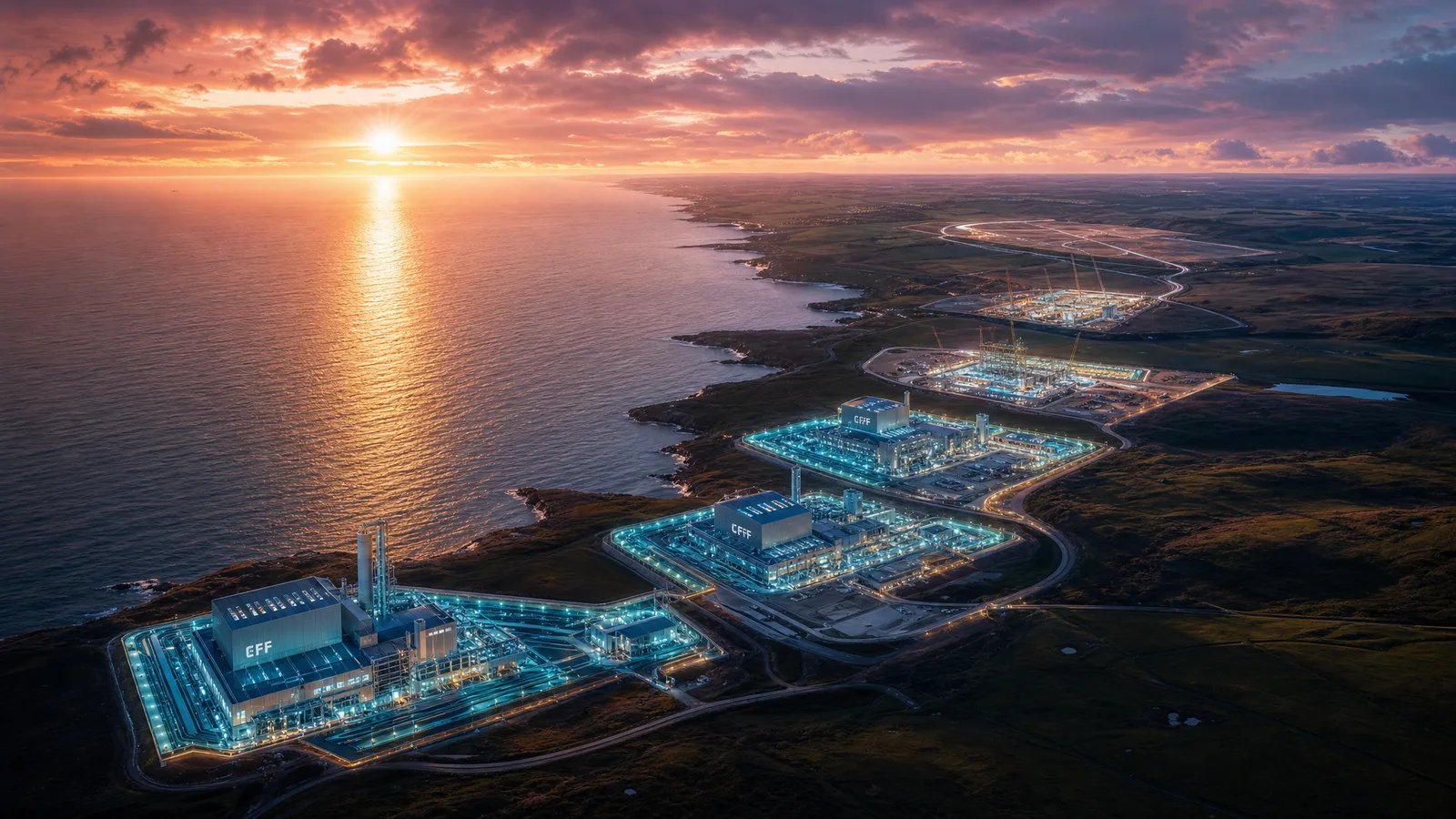
Concept art: The 25-year fleet build — sites at every stage from groundwork to full operation rolling along the British coast
A 5-phase, risk-managed rollout from licensing through to a 200-year operational horizon. £425B programme cost — ~£15B per complete site at series-production scale, plus £5B licensing. £50B/year in displaced fossil fuel imports. £2,500B lifetime saving. Government funds the early sites; fleet revenue progressively replaces public funding until the programme sustains itself. Each site is modular by design — 48 HTGR modules in 8 six-packs, with outputs added in stages as each module proves itself.
Concept art: The 25-year fleet build — sites at every stage from groundwork to full operation rolling along the British coast
Generic Design Assessment (GDA) submission for HTGR design to ONR. Environmental Impact Assessments for all 28 candidate sites. Seabed surveys, geological assessments, supply chain development, workforce training initiation, and international collaboration agreements with Japan (JAEA) and China (CNNC).
Construction of Site 1 — 48 reactor modules with 8 six-packs, built in defined stages. Stage 1 (reactors + grid connection) proves the power generation model and earns revenue from day one. Subsequent stages — desalination, Heat Halo district heating, HTSE hydrogen production, and co-product processing — are added as each module’s prerequisites are proven. First few sites use imported HTGR modules from established manufacturers; UK reactor factories are built in parallel, creating thousands of additional manufacturing jobs.
Construct remaining 27 sites in 4 tranches of 7 sites each. National hydrogen pipeline network construction. At peak: 4–5 sites under simultaneous construction, ~120 HTGR modules manufactured per year from a dedicated UK modular reactor factory. Fleet revenue from operational sites progressively replaces government co-funding. Progressive displacement of fossil fuel imports.
All 28 sites at full capacity. 21.2 Mt H₂/year production. 101.3 GWe total fleet capacity — normally all committed to hydrogen production. Zero fossil fuel imports. Hydrogen export programme begins. Continuous efficiency improvements and technology upgrades. Annual operating cost ~£5B/year. Net economic value: ~£42B/year after all costs.
Safe-Flex is not an on/off switch. Each site can redirect anywhere from 0–50% of its hydrogen-production capacity to the grid, continuously and independently, based on real-time local grid conditions. A site facing a local wind lull responds on its own; the rest of the fleet continues hydrogen production undisturbed. Full-fleet 50% engagement (up to ~51 GWe) is reserved for genuine nationwide system stress events such as a Dunkelflaute — and even then, only draws what the grid actually needs at that moment. Safe-Flex exists to support Britain’s existing wind and solar investment during periods of underperformance — not to replace or compete with it.
Rolling replacement of original HTGR modules site by site. Upgraded reactor designs benefit from 60 years of operational learning. Advanced HTSE technology installed. Production maintained throughout — no site goes fully offline. Generation 2 achieves higher efficiency than Generation 1. A third generation (2150–2235) extends sovereignty to 200+ years.
CFF is not a single monolithic build. It is a reactor core with a defined sequence of add-on modules, each installed only once its technical and commercial prerequisites are already proven. No module is built ahead of the module it depends on. Every stage earns revenue before the next stage begins.
↳ Depends on nothing else in the system
→ Unlocks everything downstream
The HTGR is the only load-bearing dependency in the whole system — every other module needs its heat, its steam, or its electricity. This stage has the most direct real-world precedent (China's HTR-PM operating commercially since 2023). It is a complete, revenue-generating power station even if nothing else is ever added.
↳ Depends on Stage 1 (reactor power/steam)
→ Unlocks Stage 3 — HTSE requires ultra-pure feedwater
Seawater cannot go directly into the electrolysers. This is not optional sequencing — it is a physical requirement. Clean water is a sellable output even before hydrogen production begins.
↳ Depends on Stage 1 only (reactor waste heat)
→ Independent — does not touch the water/hydrogen chain
Runs in parallel with Stage 2, not after it. The Heat Halo revenue model (£500/yr per home, unlimited heat and hot water) works as soon as waste heat is available. Network sized to local catchment — some sites serve 280,000 homes, others far fewer. Built using proven Danish twin-pipe methodology with UK-manufactured pre-insulated pipe (CPV Ltd, Hampshire — 40+ years of domestic production). Compulsory government rollout, street by street, as national infrastructure — the same model Britain used when mains gas replaced town gas in the 1960s.
↳ Depends on Stage 1 (700°C steam) AND Stage 2 (ultra-pure feedwater)
→ Unlocks Stage 4 (oxygen as co-product)
This is the first stage where genuine first-of-a-kind integration risk appears — HTSE scaling from pilot to full bank size has not been demonstrated at this scale. Positioning it as Stage 3 means it arrives only after Stages 1 and 2 are already proven and already earning. A delay here does not threaten anything already built.
↳ Depends on Stage 3 (direct byproducts of HTSE and desalination)
→ Revenue from co-product streams
These are not independent builds — they are byproduct streams that activate once their parent processes exist. Oxygen comes free from splitting water (no air separation plant needed — a major cost advantage over conventional oxygen producers). Minimal incremental risk once Stage 3 is running.
↳ Depends on relevant core stage already operating
→ National resilience capacity
Strategic Reserve water reserve and salt-cavern hydrogen storage. Genuinely optional per-site expansion, addable whenever national resilience planning or economics justify it. Not a Day One requirement for any individual site to be considered a success — but essential at fleet level for sovereign energy security.
All figures derived from publicly sourced comparators: China’s HTR-PM programme, X-energy Xe-100 (80 MWe — same module size as CFF), Idaho National Laboratory HTSE studies, European district heating benchmarks, and IEA pipeline data. Converted at ~$1 = £0.79.
| Rung | What It Is | Indicative Cost |
|---|---|---|
| One reactor module | 80 MWe HTGR — the atomic building block | ~£130–160M (UK-built, mature) ~£320M (first imported units) |
| One six-pack | 480 MWe — first operational increment, earning from day one | ~£0.8–1.0B (mature) ~£1.9B (first units) |
| Stage 1: Power-only site | All 48 reactors + grid + civils — electricity revenue only | ~£9B (series production) |
| Full six-output site | Complete build — all stages, all modules, all revenue streams | ~£15B (site 7+, UK series production) |
The first few sites use imported HTGR modules from established manufacturers — China’s CNNC already builds commercial HTR-PM reactors at the same 80 MWe module scale CFF specifies. This eliminates the first-of-a-kind manufacturing risk for early sites and gets the programme generating revenue while UK factories are built in parallel.
Those UK factories then take over for the remaining fleet — driving module costs down through series production, creating thousands of high-skilled manufacturing jobs, and generating tax revenue. The same model applies across the supply chain: district heating pipe is already manufactured in the UK (CPV Ltd, Hampshire — 40+ years of domestic production); HTSE electrolyser stacks, desalination units, and hydrogen infrastructure all become UK industrial capabilities as the fleet grows.
The fleet isn’t just the cost mechanism — it’s the industrial strategy. Twenty-eight sites is the volume that makes UK manufacturing viable. One-off nuclear is always ruinous; a national production line is how the price falls and the jobs multiply.
The staged-build approach saves money in two separate ways that work on different axes:
1. Build scope: A power-only site (Stage 1) is far cheaper than a full six-output site because you’re not building HTSE, desalination, district heating, or co-product processing. This is the staged-build saving — each stage is a smaller ask.
2. Learning curve: First sites use imported modules at higher unit prices; UK factories then drive the per-module cost down through volume. This is the series-production saving — the same stage gets cheaper at later sites.
Every year of delay leaves the UK exposed to system stress, imported fuel pressure, industrial decline, and a weaker ability to protect households and production in a crisis.
❌ Without CFF: the UK remains more exposed to tight winter margins, low-wind stress events, imported gas pressure, and a grid forced to absorb rising electrification without a matching sovereign resilience backbone.
✅ With CFF: 101.3 GWe of total fleet capacity from 1,344 HTGR modules (normally all committed to hydrogen production). Safe-Flex can continuously redirect 0–50% per site to the grid based on real-time local conditions — from a single site responding to a regional wind lull, up to fleet-wide engagement (~51 GWe) during a nationwide Dunkelflaute. +231 MWe surplus per site even at full hydrogen production.
❌ Without CFF: households remain exposed to volatile heating costs, winter fuel stress, and continued dependence on fragile gas-linked heating economics.
✅ With CFF: Heat Halo district heating at a flat £500/year per home — unlimited heating and hot water for up to 7.84 million homes nationally. A stable, publicly owned heat network that eliminates winter fuel stress for communities within 10 miles of each site.
❌ Without CFF: Britain remains vulnerable to imported fuel shocks, wholesale price surges, and a retail model that passes instability through to homes and businesses.
✅ With CFF: public ownership and sovereign generation create the basis for more stable long-term pricing, lower industrial energy pressure, and a system designed around domestic resilience rather than external volatility.
❌ Without CFF: heavy transport, freight corridors, and strategic fuel resilience remain tied to imported hydrocarbons and foreign-controlled supply chains.
✅ With CFF: British-made hydrogen is reserved for HGV freight, hard-to-abate industry, and strategic reserve uses where electrification alone does not fully solve the problem.
❌ Without CFF: the UK remains more exposed to drought pressure, rainfall volatility, and the absence of a large strategic freshwater buffer.
✅ With CFF: 1.4 million m³/day of desalinated water creates a strategic reserve capacity for households, agriculture, and national resilience.
❌ Without CFF: energy-intensive industry continues to face high costs, weak long-term certainty, and growing pressure to relocate production abroad.
✅ With CFF: firm power, strategic hydrogen, public coordination, and long-range infrastructure planning create the conditions for industrial retention, re-shoring, and national manufacturing renewal.
Through sovereign capital, phased delivery, and public ownership of the finished asset. The fiscal case is not built on fantasy returns. It is built on the state financing strategic infrastructure that reduces long-run exposure to imported energy, industrial decline, and external price shocks.
CFF is treated here as strategic national infrastructure: financed over the long term, delivered in phases, standardised across the fleet, and retained in public ownership once operational.
The question is not whether capital is required. The question is whether the state finances productive assets directly, or keeps paying indirectly through volatile imports, weak industrial competitiveness, system stress, and fragmented private extraction.
Because the programme runs over decades, each site is designed to begin with a strategic core and then expand through standardised modules as public funds, demand, and national priorities allow. That means capital can be deployed in disciplined phases rather than forced into a single all-at-once build.
In Treasury terms, this is a resilience and asset-creation case, not a speculative spending case: fund the core, prove the model, then scale through repeatable modules without redesigning the whole system each time.
CFF is not framed as a discretionary technology bet. It is a strategic platform intended to secure essential national functions that markets alone do not reliably provide at sovereign scale.
The home economy comes first. Any export role is secondary to domestic resilience, domestic supply, and sovereign control.
A Treasury-grade case for CFF rests on four points: first, the asset base is strategic; second, the liabilities of not building are real; third, standardisation improves delivery discipline; and fourth, public ownership allows the state to retain the long-run economic and security benefits.
That means the programme belongs in the language of resilience, productivity, import substitution, industrial retention, and sovereign asset formation — not in the language of consumer gimmicks or inflated catch-all hydrogen claims.
Fund long. Build in phases. Own the asset. Keep the strategic value in Britain.
| Fiscal Question | Without CFF | With CFF |
|---|---|---|
| Capital outcome | Ongoing exposure without creation of a sovereign strategic asset base | Capital converted into long-life nationally owned infrastructure |
| Import exposure | Continued dependence on foreign fuels and externally shaped price pressure | Progressive reduction in imported energy vulnerability |
| Delivery model | Fragmented project logic and weak system coordination | Phased fleet build with standardisation, learning, and tighter state coordination |
| Household and industry protection | Continued exposure to instability in energy and heating conditions | Stronger basis for stable public-service provision and strategic industrial support |
| Industrial effect | Higher risk of decline, relocation, and capability loss | Improved long-range conditions for retention, re-shoring, and domestic capability |
| Strategic control | Value continues to leak through foreign-linked ownership and market dependency | Public ownership preserves control over pricing logic, reinvestment, and national direction |
By DJ Waugh — Retired Engineer & Creator of Carbon Free Future