Carbon Free Future

Control Examples

Three interactive demonstrations showing how a CFF operator manages the national fleet in real time — balancing the grid, activating emergency water supply, and delivering district heating to communities. Every scenario uses the same 28-site infrastructure.

Safe-Flex Grid Operator

When renewables dip, the operator surgically ramps down hydrogen production at individual sites — freeing firm nuclear power for the grid. From a 5% nudge at one site to a full 50% fleet-wide Dunkelflaute response.

🎛️

Safe-Flex Grid Operator Console

The operator watches the national grid in real time. When renewables dip, they can surgically ramp down hydrogen production at individual sites — freeing firm nuclear power for the grid. Every combination is available, from a 5% nudge at one site to a full 50% fleet-wide response.

☀️ Trigger: Normal conditions

Wind is strong, solar is healthy, grid demand is comfortable. All 28 sites run SOEC at 100% load — maximum hydrogen production, no grid support needed.

H₂ Production
58,016 t/d
100.0% of capacity
Grid Power Freed
0.0 GW
Firm nuclear backup
Sites Adjusted
0 / 28
28 at full load
Flexibility Used
0%
of 50% max range
28 CFF Sites — SOEC Load Status
100%
Cromarty Firth
Scotland
100%
Firth of Forth
Scotland
100%
Firth of Clyde
Scotland
100%
Moray Firth
Scotland
100%
Teesmouth
North East
100%
Blyth
North East
100%
Wearside
North East
100%
Humber Estuary
Yorkshire
100%
Flamborough Head
Yorkshire
100%
Spurn Head
Yorkshire
100%
Mersey Estuary
North West
100%
Morecambe Bay
North West
100%
Barrow-in-Furness
North West
100%
Milford Haven
Wales
100%
Anglesey
Wales
100%
Swansea Bay
Wales
100%
Severn Estuary
South West
100%
Plymouth Sound
South West
100%
Falmouth
South West
100%
Thames Estuary
South East
100%
Solent
South East
100%
Dungeness
South East
100%
The Wash
East Anglia
100%
Harwich
East Anglia
100%
Lowestoft
East Anglia
100%
Wash Pipeline
East Midlands
100%
Severn Pipeline
West Midlands
100%
Belfast Lough
N. Ireland
LOAD:100%90–99%75–89%60–74%50–59%

Why This Matters

A gas peaker plant takes 10–30 minutes to start and produces carbon with every megawatt. Safe-Flex responds instantly — the SOEC load reduction is an electrical control signal, not a mechanical startup. The operator has 28 independent dials, each with a 50-percentage-point range. That is 1,400 discrete percentage points of flexibility across the fleet, deployable in any combination, at any time, with zero emissions and zero fuel cost. No other grid backup system on Earth offers that.

Unit 8 — Strategic Water Reserve

Every site includes a dedicated desalination unit producing 50,000 m³/day of fresh water — independent of hydrogen production. The operator activates them for drought relief, irrigation emergencies, or burst mains.

💧

Unit 8 — Strategic Water Reserve Console

Every CFF mega-site includes a dedicated Unit 8 — a standalone desalination unit producing 50,000 m³/day of fresh water. These units are independent of hydrogen production. They sit on standby until the operator activates them — for drought relief, irrigation emergencies, burst mains, or any situation where fresh water is needed. Drinking water output passes through an automatic remineralisation system before entering the supply network.

🌧️ Trigger: Normal rainfall, no stress

Rainfall is normal across the UK. Reservoirs and river abstractions are healthy. All 28 Unit 8 desalination units remain on standby — ready to activate in hours, but drawing no energy and producing no water. The capacity is there whenever it is needed.

Water Output
Standby
Ready to activate
Units Activated
0 / 28
28 on standby
Capacity Used
0%
of 1.4M m³/day max
People Supplied
No demand
28 Unit 8 Desalination Status
Cromarty Firth
Scotland
Firth of Forth
Scotland
Firth of Clyde
Scotland
Moray Firth
Scotland
Teesmouth
North East
Blyth
North East
Wearside
North East
Humber Estuary
Yorkshire
Flamborough Head
Yorkshire
Spurn Head
Yorkshire
Mersey Estuary
North West
Morecambe Bay
North West
Barrow-in-Furness
North West
Milford Haven
Wales
Anglesey
Wales
Swansea Bay
Wales
Severn Estuary
South West
Plymouth Sound
South West
Falmouth
South West
Thames Estuary
South East
Solent
South East
Dungeness
South East
The Wash
East Anglia
Harwich
East Anglia
Lowestoft
East Anglia
Wash Pipeline
East Midlands
Severn Pipeline
West Midlands
Belfast Lough
N. Ireland
Active — producing fresh waterStandby — ready to activate

Why This Matters

Britain has no strategic freshwater reserve. When drought hits, the only response is hosepipe bans, abstraction restrictions, and hoping it rains. Unit 8 changes that. 28 desalination units, each producing 50,000 m³/day, sitting on standby at every CFF site across the coast. The operator activates exactly what is needed, where it is needed — one site for a local burst main, four for a regional drought, all 28 for a national emergency. Fresh water that does not depend on rainfall. Drinking water that passes through automatic remineralisation before it enters the network. 1.4 million m³/day of sovereign water security that no other country has — available at the turn of a dial.

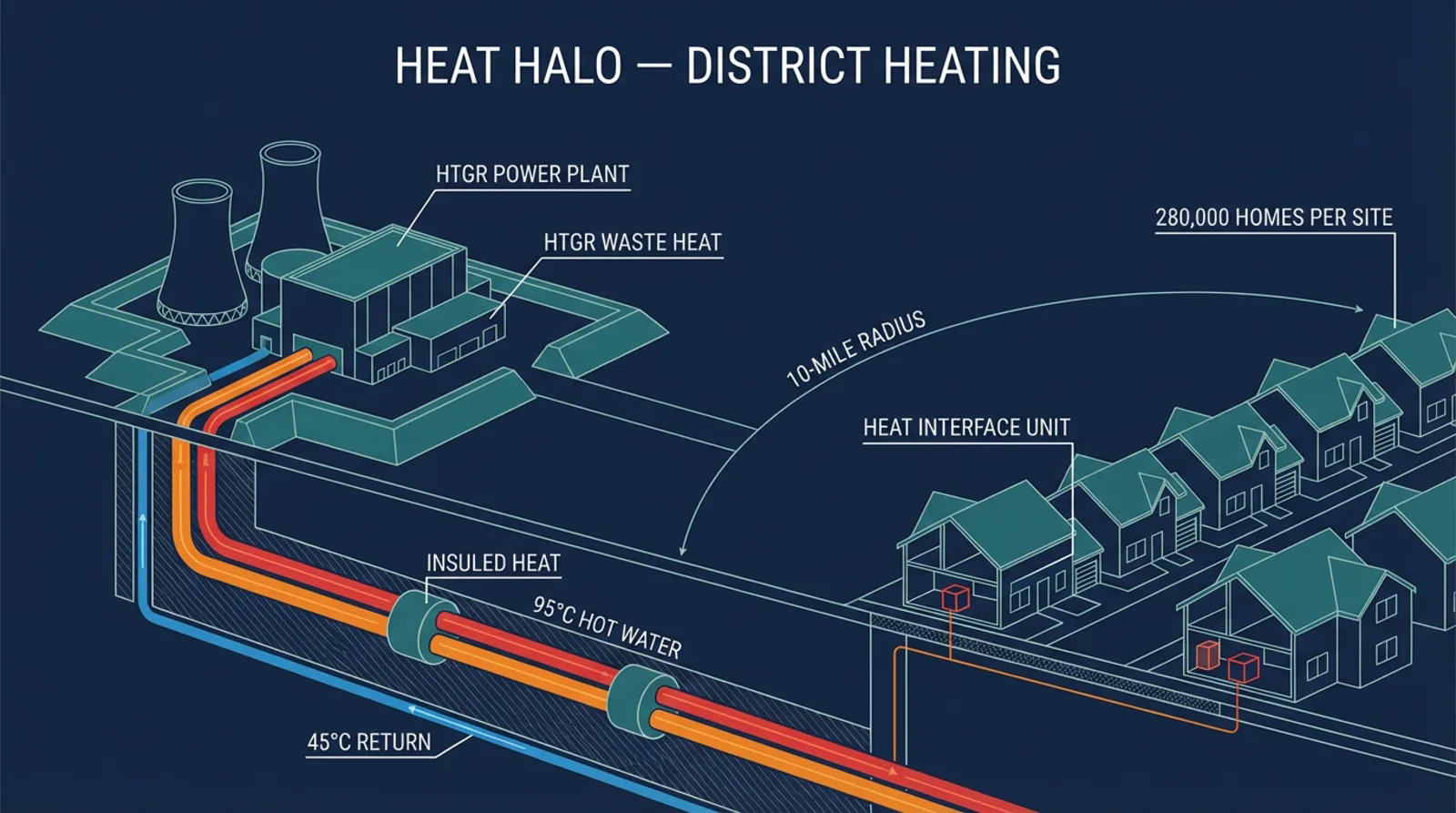
Heat Halo — District Heating Schematic

Hot water leaves the CFF site at 95°C through insulated trunk mains, with booster stations maintaining temperature. Every home receives heating and hot water — no gas boiler, no fuel bill, no carbon.

🔥

Heat Halo — District Heating Schematic

Hot water leaves the CFF site at 95°C through insulated trunk mains. Booster stations along the route maintain the flow temperature. Every home receives reliable heating and hot water at 21°C indoor comfort — no gas boiler, no fuel bill, no carbon. The cooled return water flows back to the site at ~45–52°C to be reheated.

Hover over any point on the network to see temperatures and details

FLOW → 95°C → HOT WATER TO TOWN← RETURN ← ~45–52°C ← COOLED WATER BACK TO SITE🏭CFF SITE45°🔄Booster 190°C44°Town Entry21°12 Oak Lane87°C flow50°🔄Booster 290°C48°21°7 Mill Street88°C flow50°21°3 Chapel Road86°C flow51°21°19 Park Close84°C flow52°Flow (hot)Return (cooled)Booster re-heaterHome (21°C)95°C out→ 84–90°C at homes45–52°C return
Flow Temperature
95°C
Leaving CFF site
Home Comfort
21°C
Every home, every day
Return Temperature
~45–52°C
Back to site for reheat
Booster Stations
Every 2 mi
Maintains flow quality
Homes per Site
~280,000
Within 10-mile halo

How It Works

The SMR\'s waste heat is captured by a heat exchanger and transferred to pressurised water at 95°C. This flows through insulated underground trunk mains towards the town. Every ~2 miles, a booster station tops the temperature back up to ~90°C using a small amount of site heat, maintaining delivery quality over distance. At each home, a heat interface unit (the size of a small boiler) extracts heat for radiators and hot water — the house stays at a comfortable 21°C all year round. The cooled water returns to the site at 45–52°C through the return pipe, ready to be reheated. No gas. No boiler maintenance. No fuel bill. The system runs for 200+ years with rolling maintenance — a permanent inheritance of free heat for the community.